


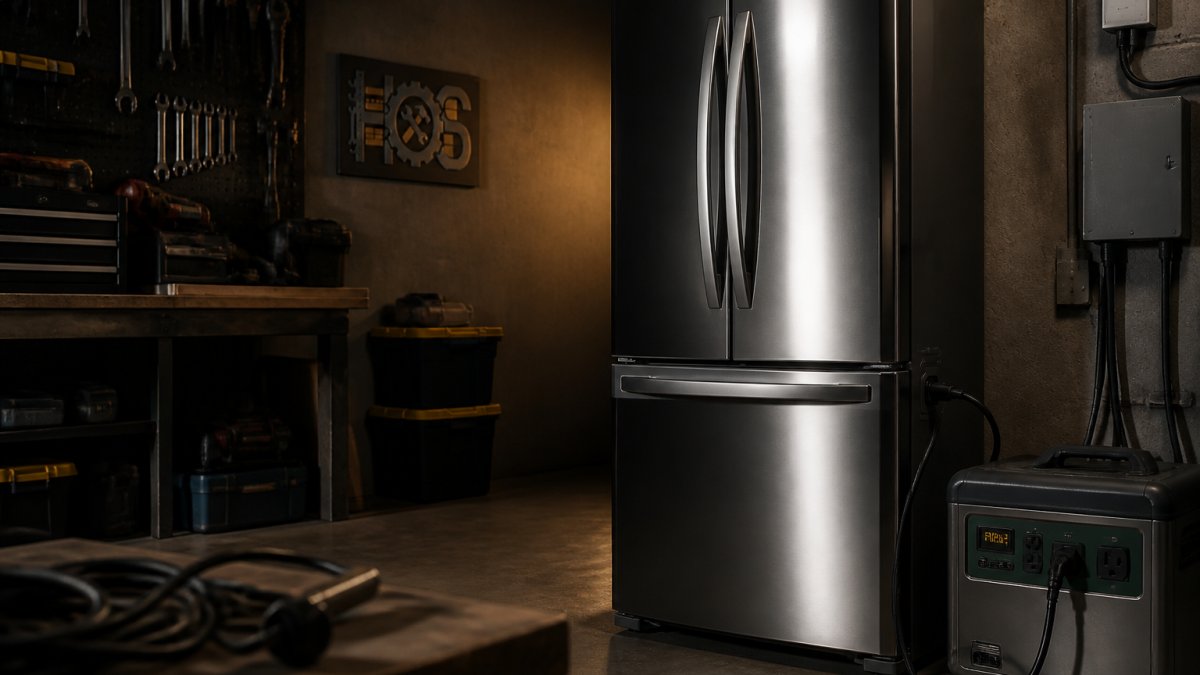
Home Backup Power for Fridge: A 2026 Guide
Table of Contents
- Why Home Backup Power for Your Fridge Matters During Outages
- Understanding Refrigerator Startup Watts and Running Power
- What Size Power Station to Run a Refrigerator
- How Long Will a Battery Backup Run a Refrigerator
- Portable Power Stations versus Whole-Home Battery Systems
- Backup Power Options: Batteries, Generators, and Solar
- Safe Connection and Indoor Use Guidance
- Choosing the Right Home Backup Power Solution
- Frequently Asked Questions
Last Updated: October 17, 2026
Why Home Backup Power for Your Fridge Matters During Outages
When the power goes out, your refrigerator becomes a ticking clock: food spoils fast and within hours you face costly losses and food safety issues. Home backup power for fridge protection isn't just convenience, it's about preserving what matters most during an outage.

At Home Outpost Supply, we understand that emergency preparedness means having reliable solutions ready before you need them. A backup power system keeps your refrigerator running when the grid fails, protecting your groceries during storms or other emergencies. The challenge isn't whether you need backup power, it's choosing the right system for your home's actual needs.
This guide walks you through sizing a power station or battery system for your fridge, calculating runtime realistically, and choosing between portable and whole-home solutions.
Understanding Refrigerator Startup Watts and Running Power
Your refrigerator doesn't use the same amount of power constantly. When it first starts, it draws a surge far higher than its normal running load, a difference critical for sizing any backup power system correctly.
Running watts versus startup surge
A full-size refrigerator typically runs at 150-800 watts depending on age, size, and efficiency. The moment the compressor kicks on, the startup surge can spike to 1,200-2,200 watts for a few seconds, which is why an undersized power station fails to start your fridge even with enough total capacity for the running load.

A portable power station rated for 600 watts continuous output might have a 1,200-watt peak capacity, and that peak handles the startup surge. Without sufficient peak power, the inverter shuts down to protect itself and your fridge never turns on.
Typical power draw for full-size and mini fridges
A full-size refrigerator (18-25 cubic feet) typically draws 150-800 watts continuously, with most modern models in the 300-600 watt range; older or poorly insulated units run higher. A mini fridge uses 40-150 watts continuously, making it much easier to power with a portable battery system.
Actual consumption varies with door openings, ambient temperature, thermostat setting, and unit age. For planning, assume a full-size fridge runs its compressor about 8-10 hours per day.
What Size Power Station to Run a Refrigerator
Choosing the right capacity requires two calculations: watt-hours for total energy storage and peak watts for the startup surge.
Calculating watt-hours and battery capacity
Watt-hours (Wh) measure total energy storage: multiply your fridge's average running watts by the hours you want to run it.
Example: A 500-watt fridge running 10 hours per day needs 5,000Wh of storage for a full day.
For a practical starting point: a 3,072Wh system like the Nature's Generator L3600 Expandable Power Station - 3,072Wh LiFePO₄ can run a typical 500-watt fridge for roughly 5-6 hours under real-world conditions. A larger whole-home system like the MyGrid 10K Whole Home Solar Generator with 10,496Wh of storage can run the same fridge for 15-18 hours or longer.

Inverter sizing and pure sine wave requirements
Your power station's inverter converts stored DC battery power into AC electricity your fridge can use. The inverter's wattage rating determines whether it can handle your fridge's startup surge.
A 600-watt inverter with 1,200-watt peak capacity can start a fridge drawing up to 1,200 watts at startup but only run continuous loads up to 600 watts. A 3,600-watt inverter handles larger loads and surge demands, suiting multiple appliances or larger refrigerators.
Pure sine wave inverters are essential for refrigerators: they produce a smooth waveform that matches grid power, while cheaper modified sine wave inverters can damage compressors and cause premature failure. Always verify your power station uses pure sine wave technology before connecting your fridge.
How Long Will a Battery Backup Run a Refrigerator
Runtime depends on battery capacity, your fridge's actual power consumption, and real-world efficiency losses. Manufacturer estimates rarely match reality.
Runtime calculations and real-world efficiency
To estimate runtime, divide usable battery capacity by average fridge power consumption. A 3,072Wh battery with 85% usable capacity (2,611Wh) divided by a 500-watt fridge equals roughly 5.2 hours of continuous operation. But most refrigerators cycle, running the compressor only 30-50% of the time.
If your fridge runs its compressor 40% of the time, that same 3,072Wh battery could theoretically run it for 13 hours. In practice, expect 8-12 hours from a 3,072Wh system powering a typical full-size fridge, accounting for inverter losses and battery degradation.
Usable capacity and conversion losses
Battery manufacturers rate capacity at maximum theoretical storage. Lithium iron phosphate (LiFePO4) batteries typically deliver 80-95% of rated capacity as usable power, so a 3,072Wh LiFePO4 battery provides roughly 2,611-2,918Wh after the battery management system's protective reserves.
Inverter efficiency typically ranges from 85-95%, so a 3,600-watt pure sine wave inverter loses about 5-10% during DC-to-AC conversion. Combined, that's 75-85% overall system efficiency, which is why a 3,072Wh system delivers closer to 2,300-2,600Wh of actual usable power to your fridge.
Portable Power Stations versus Whole-Home Battery Systems
Your choice between portable and whole-home solutions depends on budget, installation complexity, and how many appliances you want to protect.
Portable stations for flexible emergency power
A portable power station like the Nature's Generator L3600 Expandable Power Station - 3,072Wh LiFePO₄ ($1,999.99) offers flexibility: move it between rooms, use it outdoors, or power multiple devices during an outage.
Portable systems work best for shorter outages (up to 12-24 hours) or as supplemental backup, ideal if you rent, want to avoid electrical work, or need power for multiple purposes.
Whole-home systems with transfer switches
Nature's Generator L3600 Home Backup System with 6-Circuit Transfer Switch →
A whole-home battery system with a transfer switch, like the Nature's Generator L3600 Home Backup System with 6-Circuit Transfer Switch ($1,849.99), provides automatic protection for selected circuits.
Whole-home systems require professional installation but offer seamless, automatic operation: the transfer switch keeps your fridge powered without manual intervention. Larger systems like the MyGrid 10K Whole Home Solar Generator ($6,999.99) with 10,496Wh of storage can run multiple essential appliances for extended periods.
The downside is installation cost and complexity: a qualified electrician must install the transfer switch and integrate it with your electrical panel, typically $1,500-3,000 in labor beyond the equipment price.
| Backup Type | Capacity | Installation | Best For | Runtime (Typical Fridge) |
|---|---|---|---|---|
| Portable Station | 3,000-5,000Wh | None (plug and play) | Short outages, flexibility | 5-12 hours |
| Whole-Home System | 3,000-10,000Wh+ | Professional required | Extended outages, automation | 8-24+ hours |
| Expandable System | 3,000-15,000Wh+ | Professional optional | Growing capacity needs | 12-36+ hours |
Backup Power Options: Batteries, Generators, and Solar
Three main technologies power your fridge during an outage: batteries, fuel generators, and solar. Each has distinct advantages and limitations.
LiFePO4 battery technology for reliability
Lithium iron phosphate (LiFePO4) batteries are the gold standard for home backup power. They charge and discharge thousands of times with minimal degradation, typically lasting 10+ years.
The Nature's Generator L3600 Expandable Power Station - 3,072Wh LiFePO₄ uses LiFePO4 technology, making it reliable for repeated outages without capacity loss.
Portable generators and expandable capacity
Fuel-powered generators provide high output (5,000-20,000 watts) but require gasoline, propane, or natural gas. They're loud, emit exhaust fumes, and can't run indoors safely due to carbon monoxide risk.
Expandable battery systems let you add capacity over time: start with a 3,000Wh base unit and add modules as needs grow, spreading costs without replacing the entire system.
Solar recharging during extended outages
If an outage lasts more than a day, solar panels can recharge your battery system during daylight, extending runtime indefinitely.
The MyGrid 10K Whole Home Solar Generator supports up to 12,000 watts of solar panels, ideal for homeowners planning long-term energy independence. Solar needs roof or ground space and clear sky exposure but eliminates fuel costs after installation.
Safe Connection and Indoor Use Guidance
Connecting your fridge to backup power safely requires proper equipment and understanding of electrical hazards. Wrong connections damage appliances, create fire risks, or worse.
Transfer switch installation and professional setup
A transfer switch is the safest way to connect backup power to your home's electrical system.
Professional installation by a licensed electrician is strongly recommended, since the transfer switch must be installed in your electrical panel by someone qualified to work with live circuits.
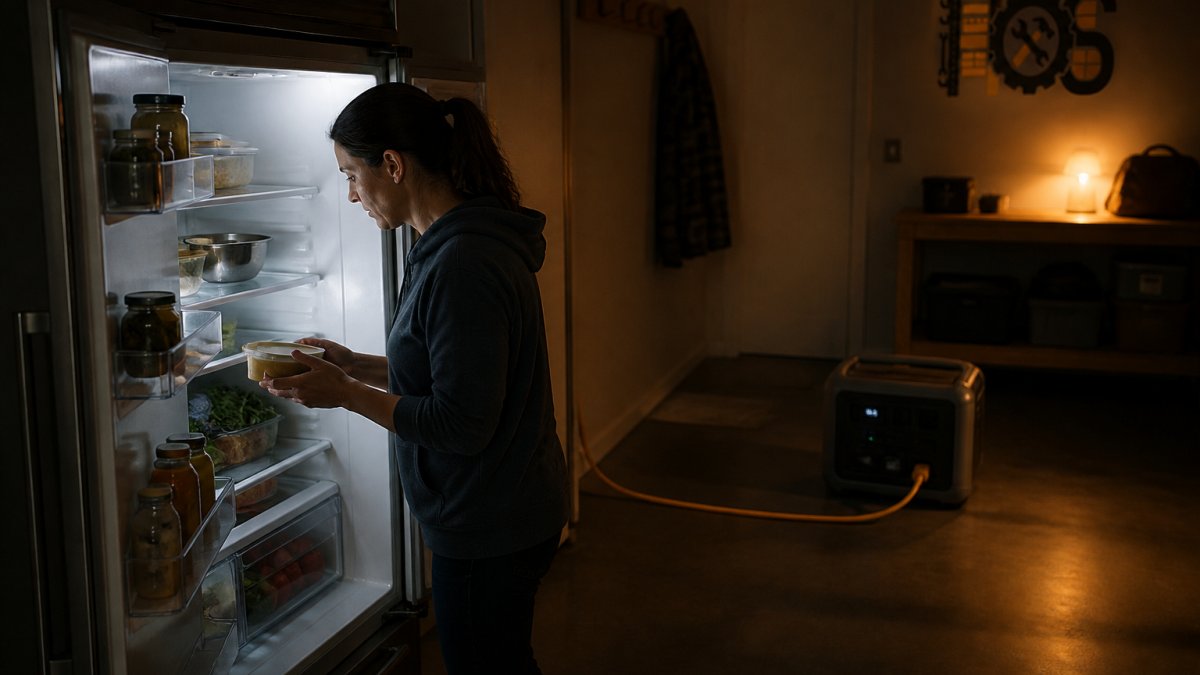
A simpler alternative for portable systems is a heavy-duty extension cord rated for your fridge's amperage: plug the power station into a standard outlet and run the cord to your fridge.
Food safety and temperature management during blackouts
A refrigerator maintains safe food temperatures (below 40°F) for only 4 hours if unopened during an outage. Backup power extends this window significantly.
If your backup power fails mid-outage, discard any perishables that have been above 40°F for more than 2 hours.
Never run a gas-powered generator indoors, in a garage, or in any enclosed space. Carbon monoxide from generator exhaust is odorless and deadly.
Choosing the Right Home Backup Power Solution
The right backup power system depends on three factors: your fridge's power requirements, how long you need to run it, and your budget for installation and equipment.
Start by measuring your fridge's actual power draw with a kill-a-watt meter over 24 hours, recording peak wattage and average consumption.
For most homeowners with a typical full-size fridge (500 watts average draw), a 3,000-5,000Wh LiFePO4 system provides 5-12 hours of backup power, enough to weather most outages. For 24-hour protection or multiple appliances, step up to a 10,000Wh whole-home system.
Home Outpost Supply carries backup power systems across this full range. The Nature's Generator L3600 Expandable Power Station - 3,072Wh LiFePO₄ at $1,999.99 covers most portable needs, while the Nature's Generator L3600 Home Backup System with 6-Circuit Transfer Switch at $1,849.99 provides whole-home protection with professional installation. For extended outages or larger homes, the MyGrid 10K Whole Home Solar Generator at $6,999.99 offers substantial capacity with solar expansion potential.
The investment in home backup power for fridge protection pays for itself the first time an extended outage hits: you preserve groceries, avoid spoilage losses, and keep your family's food safe without guesswork.
Don't let the next power outage leave you guessing whether your food is safe. Home Outpost Supply's backup power systems keep your refrigerator running when the grid fails. Get started with Home Outpost Supply and protect what matters most during outages.
Frequently Asked Questions
How many watts does it take to power a refrigerator?
A full-size refrigerator typically draws 150-800 watts while running, depending on size and age. The startup surge is much higher, often 1,200-2,000 watts or more when the compressor kicks in. A mini fridge uses 100-400 watts running and 600-1,500 watts at startup. Always check your fridge's nameplate for exact specs, and size your home backup power system to handle the startup watts, not just running watts.
What size power station do I need to run a refrigerator during an outage?
You need a power station with at least 3,000-4,000 watt-hours of capacity and 2,000+ watts of inverter output to safely handle a full-size refrigerator's startup surge and 4-6 hours of runtime. The Nature's Generator L3600 (3,072Wh, 3,600W output at $1,849.99) covers most households. For longer outages or multiple appliances, the MyGrid 10K (10,496Wh, 10,000W output at $6,999.99) provides whole-home backup. Calculate your exact needs by multiplying fridge running watts by desired runtime hours.
Is it safe to use a portable power station indoors to power a refrigerator?
Yes, portable power stations with pure sine wave inverters are safe for indoor use with refrigerators and other appliances, they produce clean AC power without exhaust fumes or noise. Keep the unit in a dry location away from moisture. Never run a gasoline or diesel generator indoors; it produces carbon monoxide and poses a serious safety hazard. Use a transfer switch for permanent whole-home installations to isolate your home from the grid safely during outages.


Leave a comment
This site is protected by hCaptcha and the hCaptcha Privacy Policy and Terms of Service apply.