


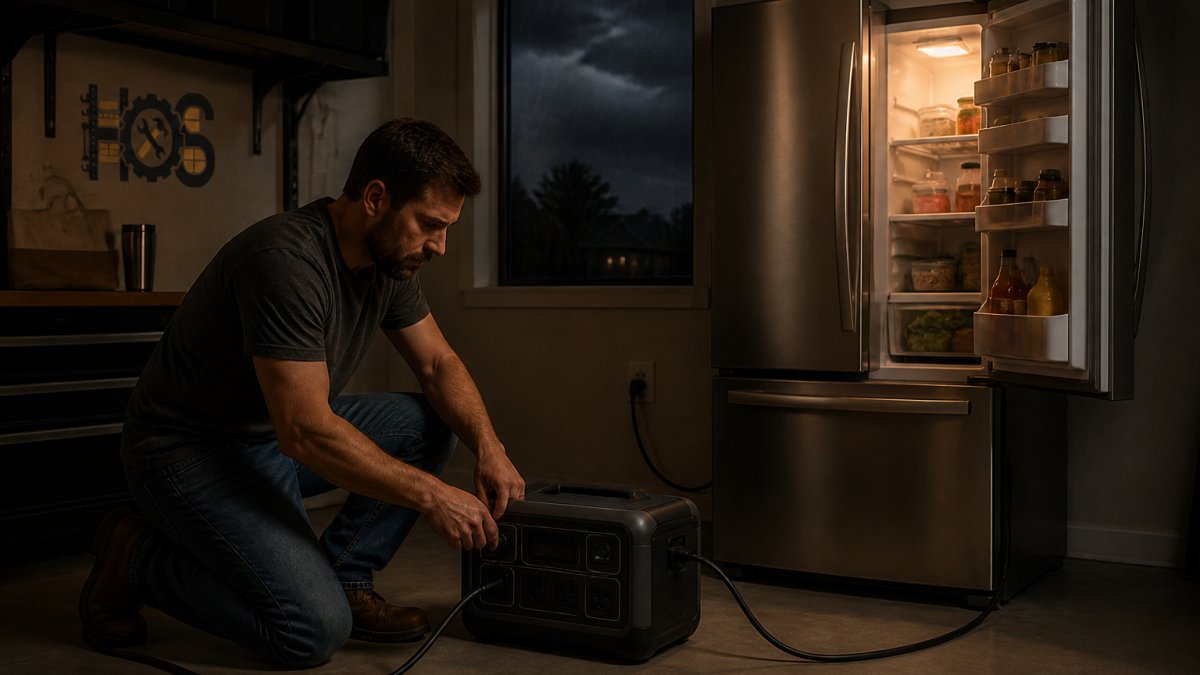
Home Energy Backup for Refrigerator During Outages
Table of Contents
- Why Your Refrigerator Needs a Dedicated Backup Plan
- Refrigerator Power Consumption Watts: What Your Fridge Actually Draws
- What Size Power Station to Run a Refrigerator
- How Long Will a Power Station Run a Refrigerator?
- How to Keep Refrigerator Cold During a Power Outage
- Choosing Your Home Energy Backup System
- Safe Connection Methods and Installation
- Conclusion
- Frequently Asked Questions
Last Updated: October 8, 2026
Why Your Refrigerator Needs a Dedicated Backup Plan
A refrigerator is the one appliance most homeowners want running when the grid fails. Losing it means spoiled food and a costly restock, which is why home energy backup for refrigerator during outages deserves its own plan.
At Home Outpost Supply, we talk with homeowners every storm season who assume a small camping battery will carry the fridge. It rarely does. The U.S.
Refrigerator Power Consumption Watts: What Your Fridge Actually Draws
Refrigerator power consumption watts decides everything else. Most full-size models draw 100 to 250 running watts, but the compressor's startup surge can spike several times higher.

That surge is the part people miss. A backup system must cover both the steady draw and the starting spike or it will shut down.
Reading Your Refrigerator's Label
Every refrigerator has a data plate, usually inside the door or on the back panel, listing voltage and amperage, sometimes wattage. If you only see amps, multiply amps by volts.
For a more accurate figure, a plug-in energy monitor records real consumption over a day or two, including door openings and room temperature.
What Size Power Station to Run a Refrigerator
Matching a power station to your fridge comes down to two numbers: continuous output and battery capacity. You need an inverter rated above your fridge's startup surge, plus enough stored energy to last the outage.

A unit with 3,600W of pure sine wave output, like the Nature's Generator L3600 Expandable Power Station, covers most household refrigerators and leaves room for small devices.
| Fridge Type | Running Watts | Startup Surge | Suggested Output |
|---|---|---|---|
| Compact/mini | 60-100 | 300-500 | 600W+ |
| Standard top-freezer | 100-200 | 600-1,200 | 1,500W+ |
| French door / side-by-side | 150-250 | 1,000-1,800 | 2,000W+ |
| Fridge plus freezer | 250-400 | 1,500-2,500 | 3,000W+ |
How Long Will a Power Station Run a Refrigerator?
Runtime depends on battery capacity, fridge efficiency, and how often the door opens. Expandable systems let you add capacity as needs grow.
Here is the math in plain terms. Multiply your fridge's running watts by the hours it actually runs per day. The compressor cycles, so real daily consumption is lower than watts times 24.
Divide your battery's usable capacity by that daily figure to estimate days of runtime.
How to Keep Refrigerator Cold During a Power Outage
Keeping food safe is about slowing temperature rise, not just restoring power. Every door opening speeds the clock. The goal is to keep the refrigerator at or below 40°F and the freezer at or below 0°F, then know when to stop trusting the contents.
The Temperature Clock You Are Racing
The USDA FoodSafety.gov guidance on food safety during power outages sets the working rule: a refrigerator holds a safe temperature for about four hours if it stays closed, and a full freezer holds for roughly 48 hours (24 hours if half full).
Homeowners often focus on runtime and ignore the temperature clock. A power station that runs the fridge three days is worthless if the door was opened hourly on day one and the interior crossed 40°F by lunch.
Monitoring Temperature, Not Just Runtime
- Place a refrigerator/freezer thermometer on the middle shelf before storm season. A dial thermometer costs a few dollars and removes guesswork.
- Check and log the temperature every two hours during an outage, so you are not relying on memory.
- Keep a second thermometer in the freezer. If it is still at 0°F, you have margin.
Thermal Mass: The Cheapest Backup You Own
A full refrigerator holds temperature far longer than an empty one because the food itself is thermal mass. Before a known storm, fill empty space with frozen water bottles or freezer packs.
Grouping food tightly in the freezer also helps. Air is a poor insulator; solid mass is not, so a packed freezer holds safe temperatures longer.
When Backup Power Runs Out
If your battery is depleted and the grid is still down, the priority shifts from running the fridge to preserving what is inside.
- Move the most valuable and most perishable items (meat, dairy, leftovers) into a cooler packed with ice or frozen packs.
- Leave the refrigerator and freezer closed. Opening it accelerates the loss.
- Do not refreeze food that thawed above 40°F. Thawed food that stayed at or below 40°F can be cooked and eaten, but refreezing changes texture and you lose track of how long it was warm.
A Short-Burst Strategy for Limited Battery
If your power station is small, you do not have to run the fridge continuously. Run it in short bursts, 30 to 60 minutes every few hours, to pull the interior temperature down, then let it coast. This trades a slightly higher average temperature for much longer runtime. It only works if you monitor with a thermometer and the fridge starts cold.
What to Do With the Food After Power Returns
Once the grid is back, check the thermometer reading first. If the fridge stayed at or below 40°F and the freezer at or below 0°F, the food is generally safe. If either crossed the threshold for more than two hours, discard the perishables. When in doubt, throw it out, a restock costs less than a hospital visit.
Nature's Generator L3600 Home Backup System with 6-Circuit Transfer Switch →
Choosing Your Home Energy Backup System
A home energy backup for refrigerator during outages can range from a single portable power station to a whole-home battery tied into your electrical panel.
For short outages, a portable station you can move room to room is often enough. For multi-day or recurring outages, a larger system with a transfer switch keeps essential circuits running without manual setup. The Nature's Generator L3600 Home Backup System pairs a 3,072Wh LiFePO4 battery with a 6-circuit transfer switch, so your fridge circuit stays live automatically.

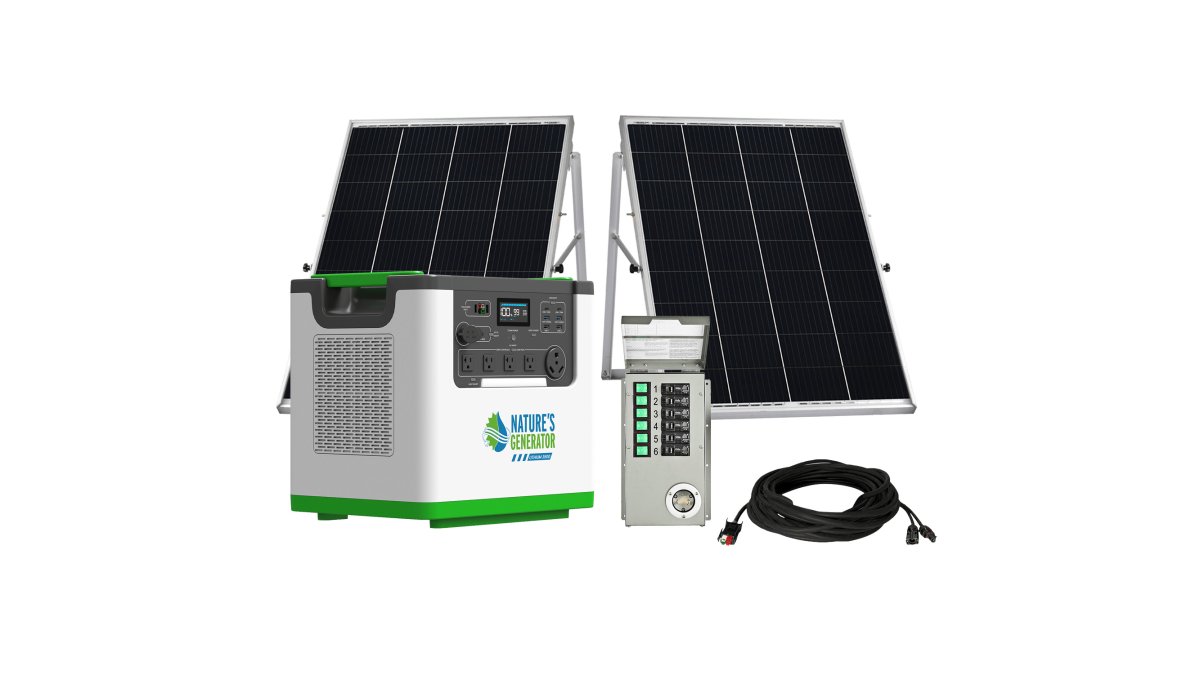
If you want to cover the whole house, the MyGrid 10K delivers 10,000W of continuous output and expandable storage for serious resilience. For lighter needs, a compact 720Wh Portable Power Station handles a mini fridge and small electronics.
| System | Capacity | Output | Best For |
|---|---|---|---|
| 720Wh Portable Station | 720Wh | 600W | Mini fridges, short outages |
| L3600 Power Station | 3,072Wh | 3,600W | Standard fridges, expandable |
| L3600 + Transfer Switch | 3,072Wh | 3,600W | Automatic fridge circuit backup |
| MyGrid 10K | 10,496Wh | 10,000W | Whole-home, multi-day outages |
Safe Connection Methods and Installation
How you connect a backup system matters as much as what you buy. The gap most articles leave open is the difference between powering one appliance and powering household circuits, and why the second can kill a line worker if done wrong. Here are the three real options.
Option 1: Direct Plug-In (Safest, Simplest)
Plug the refrigerator straight into the power station's AC outlet. No wiring, no panel work, no permit. This is the right choice for a single fridge.
What to watch:
- Use the station's pure sine wave AC outlet, not modified sine wave. Compressor motors and modern control boards run cooler and quieter on pure sine wave.
- Keep the cord run short and out of traffic. Do not daisy-chain power strips.
- Confirm the station's continuous output exceeds your fridge's startup surge, not just running watts. A unit rated 1,000W continuous may still trip on a compressor surging to 1,500W.
Option 2: Transfer Switch (The Right Way to Power Circuits)
A transfer switch is a dedicated panel, installed by a qualified electrician, that feeds selected household circuits from your backup source. It powers hardwired loads like a furnace blower or well pump and prevents your backup source from energizing utility lines.
Key mechanics:
- The switch has a set of circuits, commonly 6, 8, or 10, chosen at install time. Pick the refrigerator circuit plus essentials (lights, internet, phone charging).
- It is break-before-make: it disconnects from the utility feed before connecting to the backup feed. That physical separation makes it safe.
- Installation requires a permit and inspection in most jurisdictions. Not a DIY project.
A 6-circuit transfer switch paired with a 3,072Wh LiFePO4 battery, like the Nature's Generator L3600 Home Backup System, keeps a fridge circuit live without manual setup.
Option 3: Extension Cords (Short-Term Only)
Extension cords are acceptable for temporary use if you match the gauge to the load and distance. Undersized cords heat up, drop voltage, and can damage a compressor on startup.
- For a refrigerator on a run under 50 feet, 12-gauge is the safe default. 14-gauge is marginal; 16-gauge is not appropriate for a compressor load.
- Never run a cord through a doorway, under a rug, or through standing water.
- Never plug a cord into a home outlet to "backfeed" the house.
Backfeed Prevention: The Rule That Is Not Optional
Backfeeding means sending power from your backup source into utility lines through a home outlet or generator inlet without a transfer switch. It is dangerous for three reasons:
- It energizes lines line workers believe are dead, the reason crews treat every downed line as live.
- It can backfeed into a neighbor's service through the shared transformer.
- It can destroy your equipment when the grid returns and two power sources collide.
The only safe way to connect a backup source to household wiring is a listed transfer switch or listed generator inlet with an interlock kit, installed by a qualified electrician. There is no shortcut.
Matching the Connection to Your Outage Pattern
The right connection method depends on how often and how long you lose power.
| Outage Pattern | Recommended Connection | Why |
|---|---|---|
| Rare, short (under 4 hours) | Direct plug-in to a portable station | Cheapest, no install, covers the fridge |
| Occasional, 4-24 hours | Portable station plus a manual transfer switch | Keeps fridge circuit live without running cords |
| Recurring or multi-day | Whole-home battery with automatic transfer switch | Hands-off failover, covers more circuits |
Conclusion
Sizing home energy backup for refrigerator during outages comes down to three numbers: running watts, startup surge, and days to cover. Get those right and the rest falls into place.
At Home Outpost Supply, we stock systems built for exactly this problem, from expandable power stations to whole-home batteries with automatic transfer switches. Every order is tracked and insured, and our team helps you size it correctly.
Frequently Asked Questions
What size power station do I need to run a refrigerator?
You need a station with at least 1,500W continuous output and 2,000Wh capacity for a standard fridge. The Nature's Generator L3600 provides 3,600W and 3,072Wh, which handles most full-size refrigerators and keeps them running for 24 to 48 hours. Check your fridge label for running watts and add a 3x buffer for startup surge.
How long will a portable power station run a refrigerator?
A 3,072Wh station like the Nature's Generator L3600 can run a typical 150W refrigerator for about 20 hours under ideal conditions. Real-world runtime drops to 12-16 hours with door openings, warm room temperatures, and inverter losses. For multi-day outages, pair the station with expansion batteries or a whole-home system like the MyGrid 10K.
Can a portable power station handle a refrigerator's startup surge?
Yes, if the station's peak output exceeds the fridge's starting watts. Refrigerator compressors draw 3-5x their running watts for 1-3 seconds at startup. A fridge running at 150W may surge to 600W or more. The Nature's Generator L3600 delivers 3,600W continuous and higher peak output, which covers most residential refrigerators without tripping.
How do I keep my refrigerator cold during a power outage?
Keep the doors closed as much as possible. A full refrigerator stays safe for about 4 hours; a full freezer holds temperature for 48 hours. Place a thermometer inside to monitor temps. If you have a backup system, plug the fridge in and run it cyclically. If not, add ice blocks or frozen water bottles to extend cold retention.




Leave a comment
This site is protected by hCaptcha and the hCaptcha Privacy Policy and Terms of Service apply.