


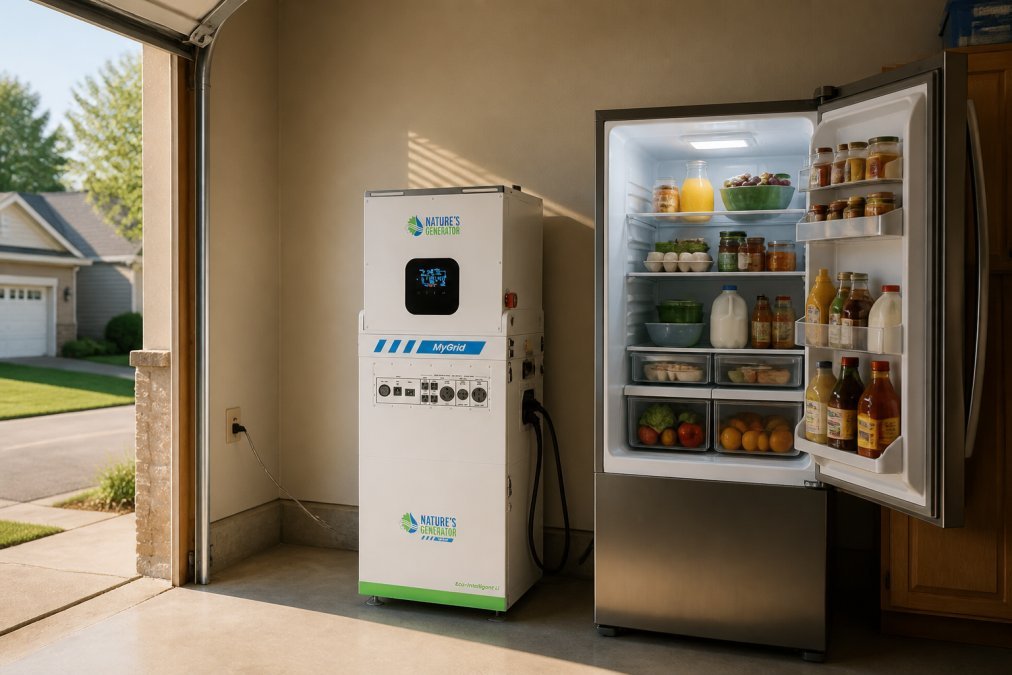
Can Portable Power Keep Fridge Running? A 2026 Guide
Table of Contents
- Can Portable Power Actually Keep Your Fridge Running?
- Understanding Refrigerator Wattage Requirements
- How to Calculate Power Station Runtime for Your Fridge
- Factors That Affect Runtime and Energy Consumption
- Maintaining Food Safety During Power Outages
- Choosing the Right Portable Power Station for Fridge Backup
- Real-World Runtime Examples and Comparisons
- Conclusion
Last Updated: August 22, 2026
Can Portable Power Actually Keep Your Fridge Running?
When the power goes out, your refrigerator becomes a ticking clock. The real question isn't whether a portable power station can keep a fridge running, it's whether you have the right one, sized correctly for your specific refrigerator's demands.

At Home Outpost Supply, we help homeowners understand how to calculate power station runtime for their fridge and choose solutions that actually work during emergencies. The answer depends on three critical factors: your fridge's wattage requirements, your power station's capacity, and how efficiently the system converts stored energy into usable power.
A 2000-watt-hour power station might keep a small portable fridge running for days, but the same station might only power a residential refrigerator for a few hours. Understanding the math behind this difference is what separates a reliable backup plan from a false sense of security.
Understanding Refrigerator Wattage Requirements
Your refrigerator doesn't draw power consistently. It cycles on and off throughout the day, and those startup moments demand significantly more power than the steady-state running phase. This distinction between running wattage and surge wattage is where most people's calculations go wrong.
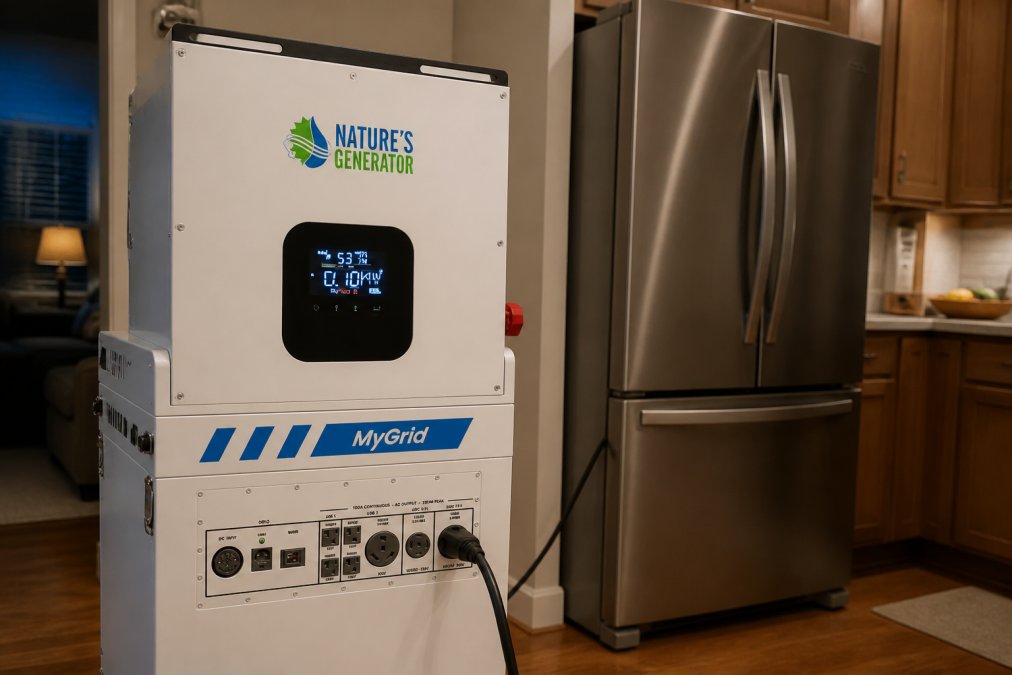
Running vs. Surge Wattage
Running wattage is the continuous power your fridge consumes when the compressor is actively cooling. Most residential refrigerators draw between 150 and 800 watts during operation, with typical mid-sized models using around 300-400 watts (energy.gov).
Surge wattage (also called startup current or inrush current) is the initial power spike when the compressor first kicks on. This surge can be 2-3 times the running wattage, sometimes reaching 1200 watts or higher. If your portable power station can't handle this surge, it will shut down immediately when the fridge tries to start. Your power station's inverter must be rated to handle both running and surge requirements.
Portable vs. Residential Refrigerators
Portable refrigerators are engineered for DC power and low energy consumption. A 12-volt portable fridge might draw only 40-60 watts, making it ideal for extended portable power station runtime.
Residential refrigerators are designed for standard 120-volt AC power and pull significantly more energy. A full-size residential fridge will drain a portable power station much faster than any portable model. If you're serious about long-term backup power during outages, this distinction matters, a portable fridge running on a modest power station can provide days of food safety, while a residential fridge on the same station might only last through the night.
How to Calculate Power Station Runtime for Your Fridge
The math is straightforward once you understand the variables. Most people skip this step and guess, which is why they end up disappointed when their power station fails to deliver.
The Watt-Hours and Inverter Capacity Formula
Start with your power station's watt-hour (Wh) capacity. A 2000-watt-hour power station contains 2000 Wh of energy.
Next, identify your fridge's running wattage. Using 400 watts as an example for a mid-sized residential refrigerator:
Watt-Hours ÷ Running Wattage = Potential Runtime in Hours
2000 Wh ÷ 400 W = 5 hours of potential runtime.
Refrigerators don't run continuously, the compressor cycles on and off, typically running 30-50% of the time. If your compressor runs 40% of the time, that 5-hour potential extends to approximately 12-13 hours of actual backup power.
Accounting for Efficiency Loss and Inverter Curves
Your power station loses energy during conversion. Inverters lose 5-15% of energy as heat during conversion, so a 2000 Wh power station with a 90% efficient inverter really gives you 1800 Wh of usable energy.
Recalculating with efficiency loss: 1800 Wh ÷ 400 W = 4.5 hours potential, or roughly 11 hours with compressor cycling factored in. This is the calculation that separates realistic expectations from marketing claims.
Factors That Affect Runtime and Energy Consumption
Your fridge's actual power consumption varies dramatically based on environmental conditions and usage patterns.
Ambient Temperature and Compressor Cycles
Ambient temperature is the single biggest driver of compressor runtime. A refrigerator in a 72-degree kitchen runs its compressor far less frequently than one in a 95-degree garage during summer. In hot conditions, a fridge that normally cycles 30% of the time might cycle 60-70% of the time, directly cutting your backup power runtime in half.
Older refrigerators with degraded seals lose cold air constantly, forcing the compressor to work harder. A well-maintained fridge with intact door seals and clean condenser coils uses significantly less energy.
Door Seals, Contents, and Depth of Discharge
Every time you open the fridge door, warm air rushes in and the compressor must work to re-cool the interior. During a power outage, resisting the urge to open the door is critical.
A full fridge retains cold better than an empty one because the food mass provides thermal mass that resists temperature change. A packed fridge might extend runtime by 20-30% compared to a mostly empty one.
Most lithium iron phosphate batteries should not be discharged below 20% capacity, as doing so accelerates battery degradation. This means a 2000 Wh power station really only provides about 1600 Wh of usable energy before you should stop drawing power.
Maintaining Food Safety During Power Outages
Your power station's job is to keep the fridge running, but the real goal is keeping food safe.
Smart Power Management and Backup Duration
Food safety experts recommend keeping a closed refrigerator at 40°F or below (fsis.usda.gov). Once power is lost, a full refrigerator maintains safe temperatures for about 4 hours if the door stays closed (fsis.usda.gov). A half-full fridge drops to unsafe temperatures in about 2 hours.
If you know a power outage will last less than 4 hours, keeping the fridge unplugged from your power station and simply keeping the door closed is the safest approach. This preserves your backup power for other critical needs.
If the outage is expected to last longer, running the fridge from your power station becomes necessary. Smart power management means monitoring your power station's remaining capacity and being prepared to switch the fridge off if the backup power drops below 20-30% capacity.
The backup duration you need depends on your outage frequency and typical outage length. If you live in an area with occasional brief outages, a 2000-watt-hour power station provides sufficient backup. If you're in a storm-prone region where outages last 12-24 hours, you need either a larger power station or a solar panel setup to recharge during the day.
Choosing the Right Portable Power Station for Fridge Backup
The market offers portable power stations ranging from 500 watt-hours to 10,000+ watt-hours, with prices spanning from under $500 to over $5,000. Finding the right size for your fridge backup requires matching your specific needs to the right specifications.
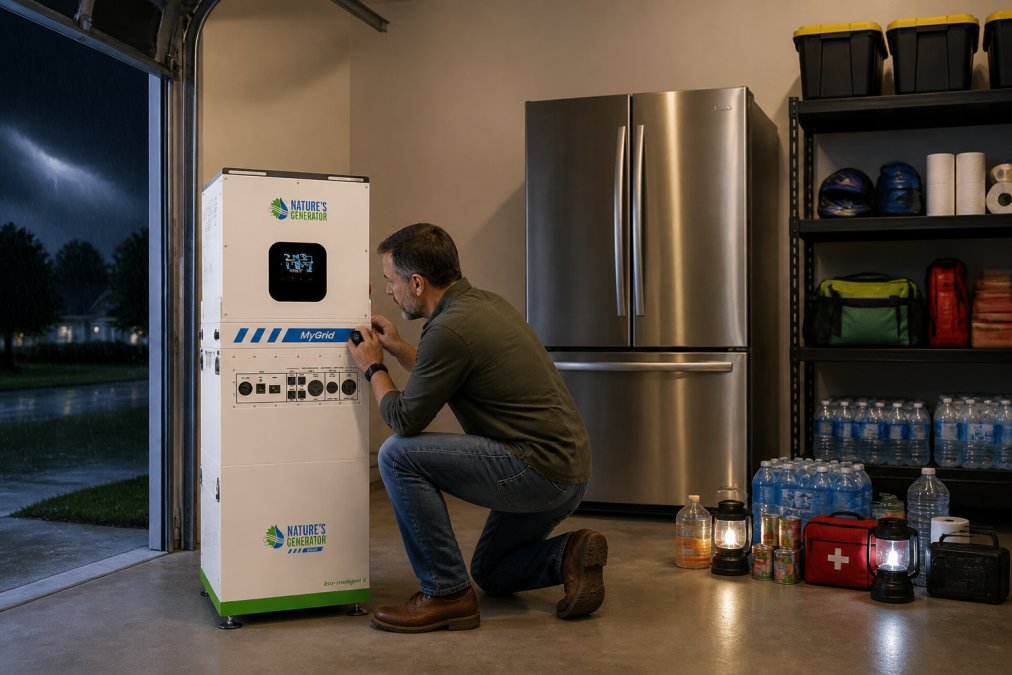
Battery Chemistry and Solar Integration
Lithium iron phosphate (LiFePO4) battery chemistry is now the standard for quality portable power stations. Unlike older lithium-ion batteries, LiFePO4 cells can handle thousands of charge cycles and maintain performance in cold weather. For fridge backup applications, this means the battery can handle the surge current when your compressor starts without stressing the pack.
Solar integration transforms a temporary backup solution into a sustainable one. A portable power station paired with solar panels can recharge during the day, providing indefinite backup power during extended outages. This is particularly valuable in storm-prone regions where multi-day outages are possible.
The Home Outpost Supply Recon 2000 Power Station ($1,999.99) offers 2016 watt-hours of LiFePO4 capacity with a 2000-watt continuous inverter, making it suitable for mid-sized residential refrigerators. The Nature's Generator Lithium 6000 Power Pod ($1,499.99) provides 6000 watt-hours and expands your runtime significantly. For whole-home backup capability, the Powerhouse V2 Solar Generator and Transfer Switch ($4,149.99) includes a manual transfer switch that safely integrates with your home's electrical panel.

Surge Protection and Inverter Efficiency
A power station's surge rating must exceed your fridge's startup current by a comfortable margin. If your fridge has a 1200-watt surge requirement, your power station's inverter should be rated for at least 1500-2000 watts continuous output.
Look for power stations that publish detailed specifications including inverter type (pure sine wave vs. modified sine wave), continuous output rating, surge capacity, and efficiency ratings. Pure sine wave inverters are essential for refrigerators; modified sine wave inverters can damage compressor motors over time.
Real-World Runtime Examples and Comparisons
Theory meets reality when you actually run your fridge on backup power.
Scenario 1: Portable Fridge in Mild Conditions A 12-volt portable refrigerator drawing 50 watts, ambient temperature 70°F, power station capacity 2000 Wh with 90% inverter efficiency.
Usable energy: 1800 Wh Actual runtime with cycling: 40-45 hours
Scenario 2: Residential Fridge in Hot Conditions A standard refrigerator drawing 400 watts running wattage, ambient temperature 85°F causing 60% compressor duty cycle, power station capacity 2000 Wh with 90% inverter efficiency.
Usable energy: 1800 Wh Actual runtime: 7.5 hours
In hot conditions, the same power station that provided 40+ hours for a portable fridge only delivers 7-8 hours for a residential unit.
Scenario 3: Residential Fridge with Solar Recharge Same 400-watt fridge paired with a 400-watt solar panel system and the MyGrid 10K Whole Home Generator ($5,099.99) which offers 10,000 watt-hours of capacity.
During daylight hours, the solar panels generate roughly 2000-2500 watt-hours. Even on a cloudy day, a 400-watt panel system generates 800-1200 watt-hours. This means the power station can recharge faster than the fridge drains it, providing indefinite backup power.
Power outages test your home's resilience. A portable power station sized for your fridge ensures that food stays safe and your family stays comfortable when the grid fails. Home Outpost Supply offers power stations ranging from compact 2000-watt-hour models to whole-home systems with solar integration. Calculate your fridge's actual wattage requirements, account for inverter efficiency, and choose a power station with surge capacity that exceeds your startup current by at least 30%. With the right backup power solution, you'll never watch food spoil during an outage again.
Frequently Asked Questions
How long will a portable power station run a refrigerator?
Runtime depends on three factors: the refrigerator's wattage draw, the power station's watt-hour capacity, and inverter efficiency. A typical refrigerator uses 150-800 watts depending on whether the compressor is running. A 2000Wh power station might run a 600-watt fridge for 2-4 hours under continuous load, but most fridges cycle on and off, extending actual runtime to 8-24 hours. Calculate your specific model's runtime using its nameplate wattage and your power station's capacity minus a percentage for inverter losses.
What size portable power station do you need to run a refrigerator?
For emergency backup, aim for at least 2000-3000 watt-hours (Wh) to handle a standard refrigerator's surge wattage and compressor cycles. Portable power stations like the Recon 2000 (2016Wh) can run most residential fridges for several hours. For longer runtime or off-grid living, consider expandable systems like the Nature's Generator Lithium 6000 Power Pod, which adds capacity through modular batteries and pairs with solar input for indefinite operation during daylight hours.
How do I calculate power station runtime for my specific refrigerator?
First, find your fridge's running wattage on the nameplate (typically 150-800W). Multiply this by the hours you need backup: running wattage × hours needed = watt-hours required. Then account for inverter efficiency losses. For example, a 600W fridge needing 8 hours of runtime requires approximately 4,800Wh of usable capacity (600W × 8 hours). Check the power station's continuous output rating to ensure it meets or exceeds your fridge's surge wattage, which is typically 2-3 times the running wattage.
Can all portable power stations handle a refrigerator's startup surge?
No. Refrigerators draw 2-3 times their running wattage when the compressor starts, called surge or peak power. A 600W fridge might draw 1,500-1,800W at startup. Your power station must have continuous output capacity above this surge wattage. Cheaper units with lower inverter capacity may shut down or damage the compressor. Higher-end systems like the Powerhouse V2 Solar Generator are designed with sufficient inverter capacity and surge protection to handle these startup currents safely.
This article was written using GrandRanker



Leave a comment
This site is protected by hCaptcha and the hCaptcha Privacy Policy and Terms of Service apply.