


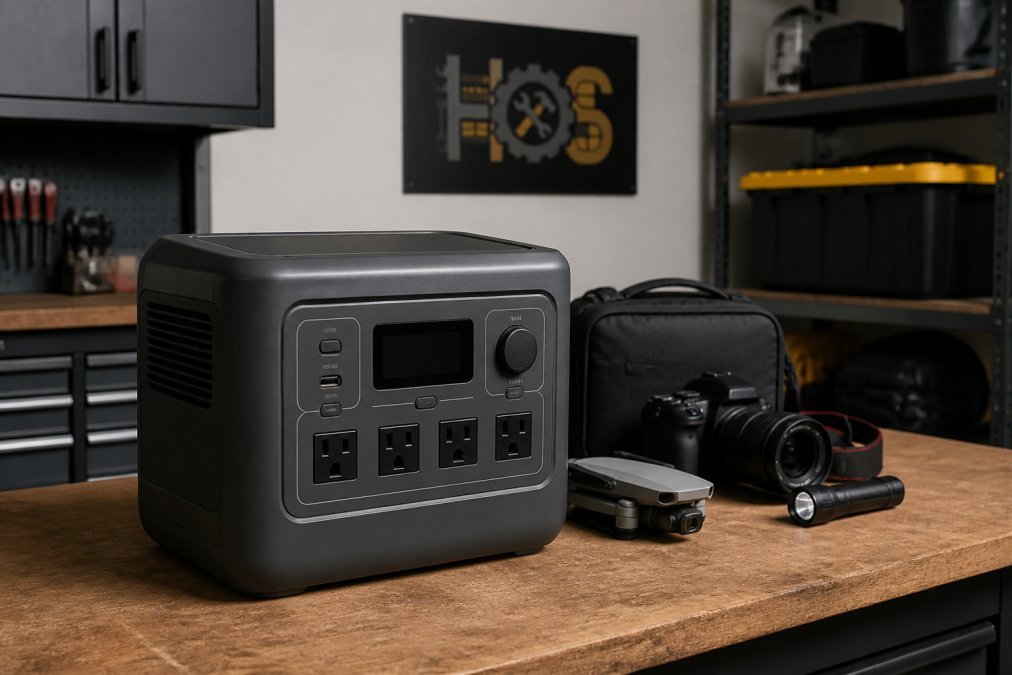
Best Portable Power Station for Home: 2026 Guide
Table of Contents
- Portable Power Station for Home: Quick Comparison
- How We Evaluated Each Portable Power Station
- Portable Power Station Capacity Explained
- How to Calculate Home Backup Power Needs
- Best Portable Power Station for Refrigerator and Critical Appliances
- 1. Recon 2000 Power Station, Best Entry-Level Home Backup
- 2. Powerhouse V2 Whole Home Solar Generator, Best Solar Bundle
- 3. Powerhouse V2 Solar Generator and Transfer Switch, Best for Home Integration
Last Updated: August 18, 2026
Choosing the right portable power station for home backup is harder than it looks. Manufacturer specs are easy to read; knowing which unit actually keeps your refrigerator running through a 12-hour outage is different. At Home Outpost Supply, we've tested and curated home energy solutions specifically for homeowners who need reliable backup power. Below, we break down capacity, battery chemistry, and real-world runtime, then recommend the best options at every price point.

The biggest mistake most buyers make is shopping by price alone. A unit that can't deliver enough surge wattage to start a refrigerator compressor is useless in an outage, regardless of storage capacity.
Portable Power Station for Home: Quick Comparison
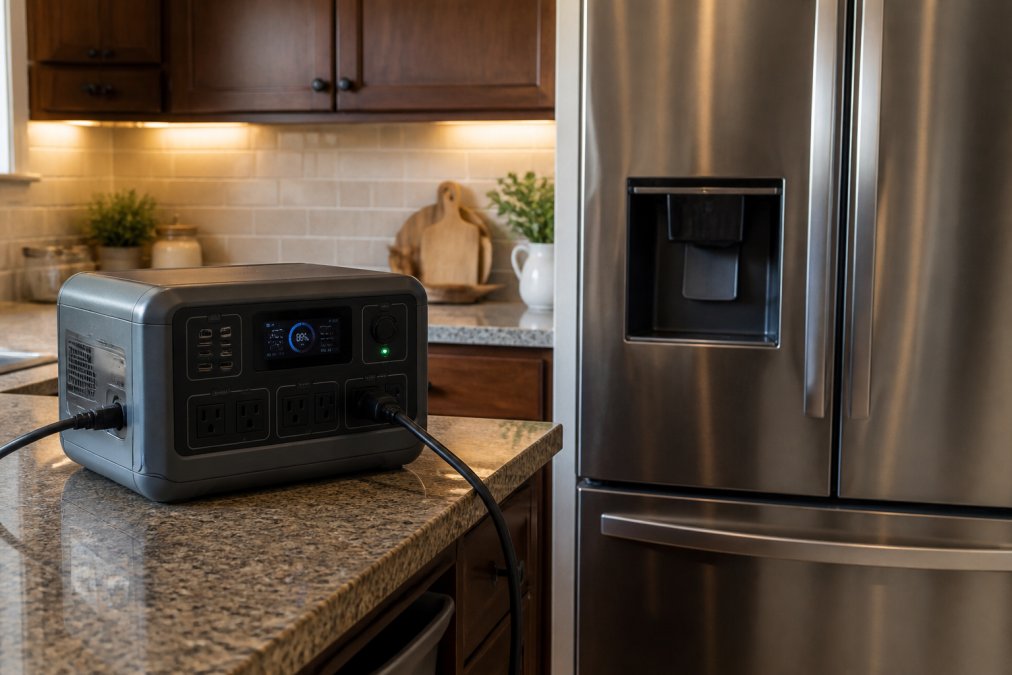
A portable power station is a rechargeable battery system with built-in inverter circuitry that converts stored DC energy into AC output for household appliances. The best units combine high energy storage capacity with a pure sine wave inverter, multiple AC outlets, USB-C power delivery ports, and solar input compatibility.
| Product | Capacity | Continuous Output | Solar Input | Price | Best For |
|---|---|---|---|---|---|
| Recon 2000 Power Station | 2,016 Wh | 2,400W | Not specified | $1,999.99 | Entry-level home backup |
| Powerhouse V2 Whole Home Solar Generator | 4,800 Wh | 7,200W | Up to 2,000W | $3,749.99 | Solar bundle, whole-home |
| Powerhouse V2 with Transfer Switch | 4,800 Wh | 7,200W | Up to 2,000W | $4,149.99 | Home circuit integration |
| MyGrid 10K Whole Home Generator | 10,496 Wh | 10,000W | Up to 12,000W | $5,099.99 | Maximum capacity |
Quick Picks:

- Best Entry-Level: Recon 2000, rugged, 2,400W pure sine wave inverter, ready to run critical appliances
- Best Solar Bundle: Powerhouse V2 Whole Home Solar Generator, panels included, 4,800 Wh, expandable
- Best Home Integration: Powerhouse V2 with Transfer Switch, safe grid-to-backup switching, 7,200W output
How We Evaluated Each Portable Power Station
Every unit was evaluated against criteria that matter to homeowners facing real outages: energy storage capacity in watt-hours, continuous AC output and surge wattage, battery chemistry and projected cycle life, solar input capability and recharge time, portability, and ease of home integration. Units with a pure sine wave inverter scored higher because sensitive electronics, including modern refrigerators, require clean AC waveforms. Pass-through charging capability and battery management systems were treated as significant differentiators.
Portable Power Station Capacity Explained
Energy storage capacity is measured in watt-hours (Wh) or kilowatt-hours (kWh), and it tells you how much total energy a unit holds, not how fast it can deliver power. A 2,000 Wh portable power station holds roughly 2 kWh of usable energy. If your refrigerator draws 150W continuously, that unit theoretically runs it for about 13 hours, though real-world runtime is typically 20-30% lower due to inverter efficiency losses and depth of discharge limits.
Peak power, also called surge wattage, is a separate spec describing the maximum instantaneous output the inverter can sustain for a few seconds to start motor-driven appliances. Continuous output is what the unit can deliver indefinitely. Never confuse the two.
For home backup use, a practical minimum is 1,500 Wh for basic coverage of phone charging, lighting, and a small refrigerator. Whole-home backup for critical circuits requires 4,000 Wh or more, especially if running a full-size refrigerator, sump pump, and medical equipment simultaneously.
Battery Chemistry: LiFePO4 vs. Lithium-Ion
The two dominant chemistries in portable power stations are lithium iron phosphate (LiFePO4) and standard lithium-ion (typically NMC or NCA).
LiFePO4 cells are more thermally stable and less prone to thermal runaway under stress or overcharge. They tolerate deeper discharge cycles without significant capacity loss and operate safely across a wider temperature range. The tradeoff is lower energy density; a LiFePO4 pack is physically larger and heavier for the same watt-hour rating compared to NMC lithium-ion.
Lithium-ion (NMC/NCA) cells pack more energy into a smaller, lighter form factor, which matters for portability. The downside is reduced cycle life and greater sensitivity to heat and deep discharge.
For home backup specifically, LiFePO4 is the superior choice. You're leaving this unit in a garage or utility room where thermal stability and longevity outweigh weight savings. According to Department of Energy's energy storage safety guidance, lithium iron phosphate chemistry is among the most stable for stationary and semi-stationary storage applications.
Cycle Life and Long-Term Battery Degradation
A battery cycle is one full charge-to-discharge sequence. LiFePO4 cells in quality portable power stations typically rate for 2,000 to 3,500 cycles before capacity drops to roughly 80% of original. Standard lithium-ion units often rate for 500 to 1,000 cycles under similar conditions. If you cycle a LiFePO4 unit once per week during storm season, the pack can last 40 to 70 years in theory, though real-world factors reduce that considerably.
Depth of discharge matters as much as chemistry. Running a battery to zero repeatedly accelerates degradation faster than any other single factor. Quality units with an integrated battery management system (BMS) automatically limit discharge depth to protect cell longevity. The MyGrid 10K and Powerhouse V2 both include BMS protection, which is non-negotiable for long-term use.
How to Calculate Home Backup Power Needs
Calculating home backup power needs requires three steps: list your critical appliances, find their wattage, and estimate how many hours you need to run them.
Step 1: List critical appliances. For most homeowners, priorities include a refrigerator, phone and device charging, lighting, a sump pump (if applicable), and medical devices like CPAP machines.
Step 2: Find running wattage and surge wattage. The running wattage is on the appliance nameplate or in the manual. Surge wattage is typically two to three times the running wattage for motor-driven appliances.
Step 3: Calculate total watt-hours needed. Multiply each appliance's running wattage by the hours you expect to run it, then add them together.
| Appliance | Running Watts | Hours Needed | Watt-Hours |
|---|---|---|---|
| Full-size refrigerator | 150W | 24 hrs | 3,600 Wh |
| LED lighting (4 fixtures) | 40W | 8 hrs | 320 Wh |
| Phone/laptop charging | 100W | 4 hrs | 400 Wh |
| Sump pump | 800W | 2 hrs | 1,600 Wh |
| CPAP machine | 30W | 8 hrs | 240 Wh |
| Total | 6,160 Wh |
Add a 25-30% buffer for inverter efficiency losses, and this homeowner needs roughly 7,700-8,000 Wh of usable capacity for 24 hours of critical appliance coverage. That points squarely at the 10 kWh class.
Best Portable Power Station for Refrigerator and Critical Appliances
The best portable power station for running a refrigerator needs at least 2,000W continuous output, 3,000-4,000W surge capacity, and a minimum of 1,500 Wh of storage for meaningful runtime. A pure sine wave inverter is mandatory; modified sine wave units can damage modern refrigerator compressor motors over time.
A full-size refrigerator draws roughly 100-200W while running, but the compressor surge at startup can hit 600-1,200W depending on the model. Any unit in this guide handles that surge comfortably. The more relevant question is how long it runs before needing a recharge.
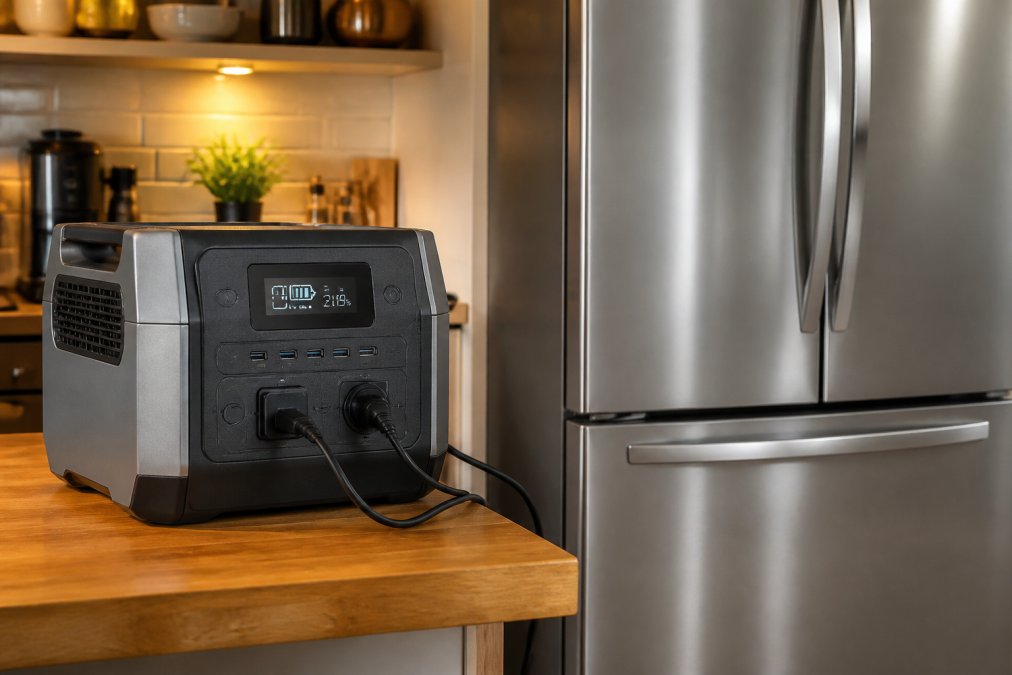
For a single refrigerator plus basic lighting and device charging, the Recon 2000 at 2,016 Wh covers roughly 10-12 hours of real-world runtime. For 24+ hours without solar recharging, you need the Powerhouse V2's 4,800 Wh capacity or the MyGrid 10K's 10,496 Wh. The Powerhouse V2 also delivers 120/240V output through its pure sine wave inverter, handling a wider range of appliances than units limited to 120V.
1. Recon 2000 Power Station, Best Entry-Level Home Backup
The Recon 2000 is the right starting point for homeowners who want serious backup power without the complexity of a whole-home system.
At 2,016 Wh of energy storage and a 2,400W pure sine wave inverter, it handles a refrigerator, device charging, and lighting simultaneously. The rugged design features reinforced aluminum shell, oversized wheels, and a telescoping handle, making it portable between locations.
Specifications:
- Capacity: 2,016 Wh
- Continuous output: 2,400W pure sine wave
- Form factor: Wheeled, telescoping handle
- Price: $1,999.99
What works: The 2,400W pure sine wave inverter is the standout. Many entry-level units in this capacity range use modified sine wave inverters that can stress sensitive electronics. The rugged design adds real durability for heavy use.
What to watch: At 2,016 Wh, runtime is limited for whole-home use. Plan for 10-14 hours of refrigerator-plus-lighting runtime before recharge.
Best for: Homeowners who want reliable backup for a refrigerator and critical devices during shorter outages, or those needing portable power for outdoor work.
2. Powerhouse V2 Whole Home Solar Generator, Best Solar Bundle
For homeowners who want grid independence and solar recharging built in from day one, the Powerhouse V2 Whole Home Solar Generator is the most complete out-of-the-box solution.
The system pairs a 4,800 Wh LiFePO4 battery with a 7,200W pure sine wave inverter capable of 120/240V output, handling heavy-duty appliances that 120V-only units cannot. The included high-output solar panels mean you can recharge during daylight hours, extending effective runtime through multi-day outages. Solar input capacity reaches 2,000W, and the system also accepts wind input up to 1,000W for maximum off-grid flexibility.
Specifications:
- Capacity: 4,800 Wh
- Continuous output: 7,200W pure sine wave
- Solar input: Up to 2,000W
- Voltage: 120/240V
- UPS functionality: 10ms switchover
- Expandable: Up to three units combined (21,600W total)
- Price: $3,749.99
What works: The 10ms UPS functionality is significant. Most portable power stations have a switchover delay that causes computers and sensitive electronics to reset. A 10ms transition is fast enough to prevent interruption for most devices. The expandable architecture means you can grow the system over time without replacing the core unit.
What to watch: At 4,800 Wh, a single unit running a full home load will deplete faster than solar can replenish on a cloudy day. Extended overcast weather still requires grid recharging or a generator input.
Best for: Homeowners in storm-prone regions who want solar-assisted backup power with room to expand, and those prioritizing long-term energy independence.
3. Powerhouse V2 Solar Generator and Transfer Switch, Best for Home Integration
The biggest gap in most portable power station setups is safe connection to home circuits. Without a transfer switch, you're running extension cords through the house, which is inconvenient and a safety hazard. This bundle solves that problem directly.
The Powerhouse V2 with Transfer Switch includes the same 4,800 Wh battery and 7,200W pure sine wave inverter as the solar generator bundle, but adds a manual transfer switch for safe switching between grid power and backup power. This separates a genuine home backup system from a portable generator you plug appliances into individually.
Specifications:
- Capacity: 4,800 Wh
- Continuous output: 7,200W pure sine wave
- Voltage: 120/240V
- Transfer switch: Manual, included
- UPS functionality: 10ms switchover
- Solar input: Up to 2,000W
- Price: $4,149.99
A transfer switch isolates your home circuits from the grid during an outage, preventing backfeed that could injure utility workers and allowing safe, organized power distribution to selected circuits. According to National Electrical Code guidelines on transfer switches, proper transfer switch installation is required for safe connection of any backup power source to home wiring.
What works: The plug-and-play design keeps installation accessible for homeowners who aren't electricians. The manual transfer switch is simpler and more reliable than automatic systems for most residential applications.
What to watch: Manual transfer switches require you to physically operate them during an outage. For fully automatic switchover, consider the MyGrid 10K bundle with the 50A automatic transfer switch.
Best for: Homeowners who want a properly integrated home backup system with solar capability and don't want to source a transfer switch separately.
Finding the right portable power station for home backup requires matching capacity to your actual load, not just buying the biggest unit available. Homeowners who experience storm-related outages and want to protect food, medical equipment, and critical circuits need a system sized for real runtime, with a battery chemistry that holds up over years of use. Home Outpost Supply carries the full Powerhouse V2 and MyGrid 10K lineup, with insured shipping and dedicated support before and after purchase. Add the Powerhouse V2 Whole Home Solar Generator or the Transfer Switch bundle to your cart and have genuine backup power in place before the next outage season.
Frequently Asked Questions
Can a portable power station run a house during an outage?
A standard portable power station can run critical appliances, a refrigerator, lights, phone chargers, and a router, but not an entire home. Systems like the MyGrid 10K, with 10,496Wh of LiFePO4 storage and 10,000W continuous output, come closest to whole-home coverage. For full-house backup, pairing a high-capacity unit with a transfer switch is the most reliable approach.
How long will a portable power station run a refrigerator?
A typical refrigerator draws 100-400W and averages around 150Wh per hour of actual consumption. A 2,000Wh station like the Recon 2000 can run a standard fridge for roughly 10-15 hours depending on the model and ambient temperature. A 4,800Wh system like the Powerhouse V2 extends that to 30+ hours, and the MyGrid 10K's 10,496Wh battery can cover several days of refrigerator runtime.
Are portable power stations safe to use indoors?
Yes. Unlike gas generators, portable power stations produce no exhaust fumes and are completely safe to operate indoors. LiFePO4 battery chemistry adds another layer of safety, it is thermally stable and far less prone to overheating than older lithium-ion cells. All units listed here include a battery management system (BMS) that monitors temperature, voltage, and current to prevent unsafe operating conditions.
What should I look for when buying a home power station?
Focus on four specs: total energy storage in watt-hours (Wh), continuous AC output in watts, battery chemistry (LiFePO4 outlasts standard lithium-ion), and recharge options. For home backup, also check whether the unit supports a transfer switch for safe grid-to-backup switching, and whether it uses a pure sine wave inverter, sensitive electronics like medical equipment and modern appliances require one.
Is it worth getting a portable power station for home backup?
For homeowners in storm-prone areas or regions with frequent outages, a portable power station pays for itself in protected food, uninterrupted work, and peace of mind. Unlike a gas generator, there is no fuel to store, no maintenance schedule, and no exhaust. Systems with solar input go further, they recharge from sunlight during extended outages when the grid stays down for days.
This article was written using GrandRanker


Leave a comment
This site is protected by hCaptcha and the hCaptcha Privacy Policy and Terms of Service apply.