


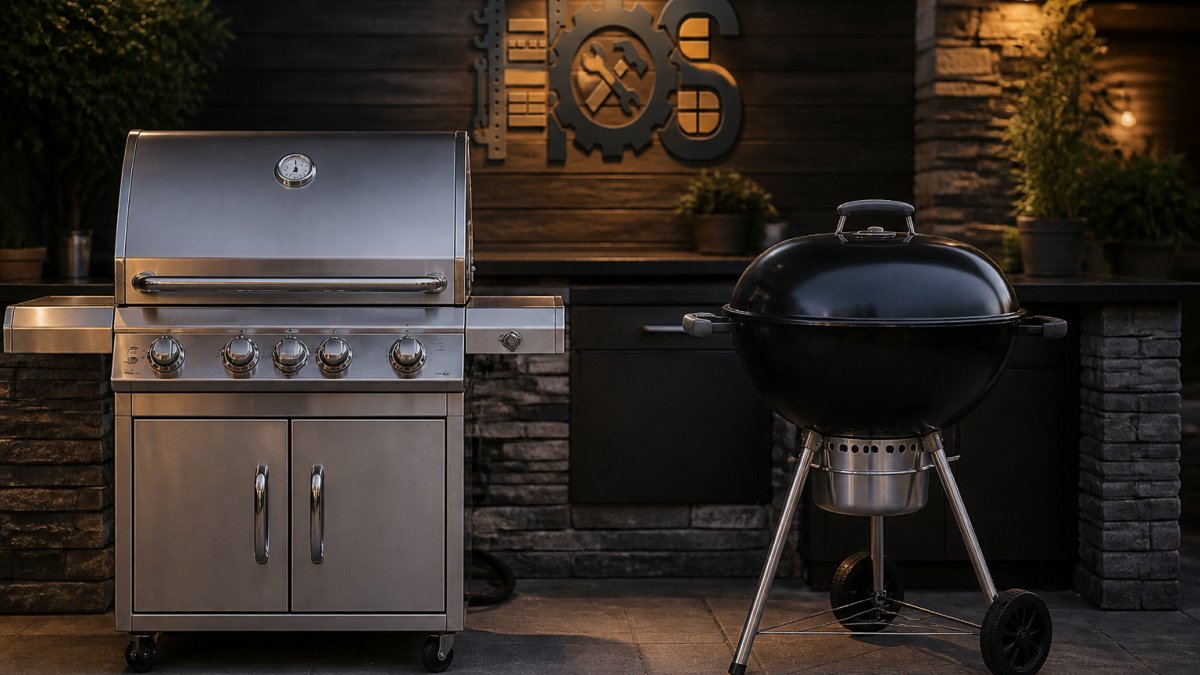
Gas Grill vs Charcoal Grill for Outdoor Kitchens
Table of Contents
- Gas Grill vs Charcoal Grill for Outdoor Kitchens: Key Differences
- Gas vs Charcoal Grill Pros and Cons
- Can You Use a Charcoal Grill in an Outdoor Kitchen?
- Natural Gas vs Propane Grill: Fuel Infrastructure and Costs
- Best Grill for an Outdoor Kitchen: Decision Framework
- Total Cost of Ownership and Year-Round Weather Exposure
- Conclusion
- Frequently Asked Questions
Last Updated: October 18, 2026
Gas Grill vs Charcoal Grill for Outdoor Kitchens: Key Differences
The gas grill vs charcoal grill decision comes down to one trade-off: control versus character. Gas gives you instant, dial-in heat and easy cleanup. Charcoal gives you smoke, searing intensity, and a hands-on cooking experience. At Home Outpost Supply, we sell outdoor kitchen islands built around gas, so we will be upfront about where charcoal still wins. This guide breaks down flavor, heat, safety, fuel costs, and installation so you can pick the right setup for your patio.

Here is the short version before we get into the details: most outdoor kitchen builds are designed for gas, and that is not an accident.
Flavor Differences Between Gas and Charcoal
Charcoal wins on smoke flavor, and it is not close. Burning charcoal briquettes or lump charcoal produces smoke that settles into food and creates the aroma people associate with backyard cooking. Gas produces almost none on its own.
You can close that gap. Add a smoker box with wood chips, or use a grill with an infrared rear burner and a rotisserie. But if smoke flavor is your main reason for grilling, charcoal is the simpler path.
Heat Output and Temperature Range
Gas grills deliver steady, measurable heat. A well-built island grill can push 85,000 BTUs across six burners, which gives you a wide temperature range and predictable heat control. Charcoal burns hotter at its peak but is harder to hold at a steady temperature.
Searing performance favors different tools. Charcoal gets ripping hot over a full chimney. Infrared gas burners reach searing temperatures in seconds and hold them. For low-and-slow cooking, gas with adjustable burners is easier to manage overnight.
Gas vs Charcoal Grill Pros and Cons
Gas pros: fast preheating, precise temperature adjustment, no ash removal, easy grease management, and simple cleanup. Gas cons: less smoke flavor, dependence on fuel supply, and higher upfront cost for a built-in unit.
Charcoal pros: stronger smoke flavor, intense searing heat, lower entry price, and full control over fire management. Charcoal cons: longer startup time, messy ash removal, uneven heat distribution without practice, and real ventilation concerns indoors or under a roof.
| Factor | Gas Grill | Charcoal Grill |
|---|---|---|
| Preheating | 10-15 minutes | 20-30 minutes |
| Temperature control | Dial-adjustable burners | Vent and fuel management |
| Smoke flavor | Low without added wood | High |
| Cleanup | Grease tray, minimal ash | Ash removal required |
| Best for | Built-in outdoor kitchens | Portable or open-air setups |
Can You Use a Charcoal Grill in an Outdoor Kitchen?
Yes, but with conditions. Charcoal grills produce carbon monoxide and heavy smoke, so they cannot go inside an enclosed outdoor kitchen structure or under a solid roof without serious ventilation. Many built-in island designs are engineered for gas for exactly this reason.


Ventilation, Clearances, and Safety Codes
Charcoal needs open-air placement with clearance from combustible surfaces. Check your local building code and follow the NFPA outdoor cooking safety guidance on clearance distances. Gas units have their own rules: proper gas line connections, shutoff valves, and clearance from structures. Never place any grill inside a garage or screened enclosure.
Natural Gas vs Propane Grill: Fuel Infrastructure and Costs
For a built-in outdoor kitchen, the fuel decision is really an infrastructure decision. Natural gas and propane behave differently at the appliance, at the meter or tank, and at the permit office, and those differences drive both installation cost and long-term operating cost.
Natural gas is delivered through a hardwired line, usually 1/2-inch or 3/4-inch black iron or corrugated stainless steel tubing (CSST) run from the house meter to the island. A licensed plumber or gas fitter typically handles the run, and most jurisdictions require a permit and inspection before the line is energized. Because the line is permanent, you never swap a tank, never run out mid-cook, and never store fuel on the patio. The trade-off is that the island location is fixed once the line is buried or stubbed out, and adding a line after the patio is poured is far more expensive than roughing it in during construction.
Propane is stored in a tank, commonly a 20-pound exchange cylinder for freestanding grills, or a larger 100-pound or 250-gallon tank for a permanent island. A built-in propane grill needs a regulator, a hose, and a tank enclosure or remote tank with a line run to the island. Propane delivers more BTUs per cubic foot than natural gas, so a propane orifice is smaller than a natural gas orifice for the same burner; grills are typically sold jetted for one fuel or the other, and converting usually means swapping orifices and the regulator, not just changing the hose. Check with the manufacturer before converting, many built-in grill warranties are voided by field conversion.
Sizing and pressure. Natural gas appliances are rated at low pressure (typically 7 inches water column for residential grills), while propane grills run at 11 inches water column. A high-BTU island grill, say 85,000 BTUs across six burners plus a side burner, needs a gas line sized for that total load, not just the grill's main burners. Undersized lines cause low flame, long preheat times, and sooting. A plumber sizing the run will add up every appliance on the island (grill, side burner, outdoor refrigerator if it is gas-fired, patio heater) and size the pipe or tubing accordingly.
Cost picture. Natural gas installation typically runs several hundred to a few thousand dollars depending on run length, trenching, permitting, and whether the meter needs upgrading; propane installation is usually cheaper upfront because it needs only a tank, regulator, and short line, but you carry the cost of refills and tank exchange. Per cook, natural gas is usually the cheaper fuel in most markets, while propane costs more per BTU but requires no utility connection. For a permanent island, the natural gas premium is usually recovered over years of use; for a portable or renter-friendly setup, propane wins on flexibility.
Napoleon Prestige® PRO 500 Smart Gas Grill with SIZZLE ZONE® →
Storage and code notes. Propane cylinders have storage limits, many codes restrict how many pounds of propane can be stored near a structure or inside a garage, and cylinders must be kept upright and away from ignition sources. Natural gas has no on-site storage, which simplifies code compliance but puts the emphasis on proper line sizing, shutoff valves, and inspection. Confirm local requirements with your building department before rough-in, and follow the grill manufacturer's clearance and installation instructions, which govern the warranty.
Best Grill for an Outdoor Kitchen: Decision Framework
The best grill for an outdoor kitchen is a gas unit, for most households. Built-in islands, hardwired fuel, and dial-in heat control fit permanent outdoor spaces better than charcoal's open-flame, ash-producing setup.
Use this framework:
- Cooking style: Want smoke and fire theater? Charcoal. Want weeknight speed and precision? Gas.
- Space: Permanent built-in island? Gas. Portable or open patio? Either works.
- Household size: Large families and entertaining favor gas for volume and speed.
- Budget: Charcoal costs less upfront. Gas costs less per cook over time.
- Installation: Natural gas line available? Go gas. No line? Propane or charcoal.
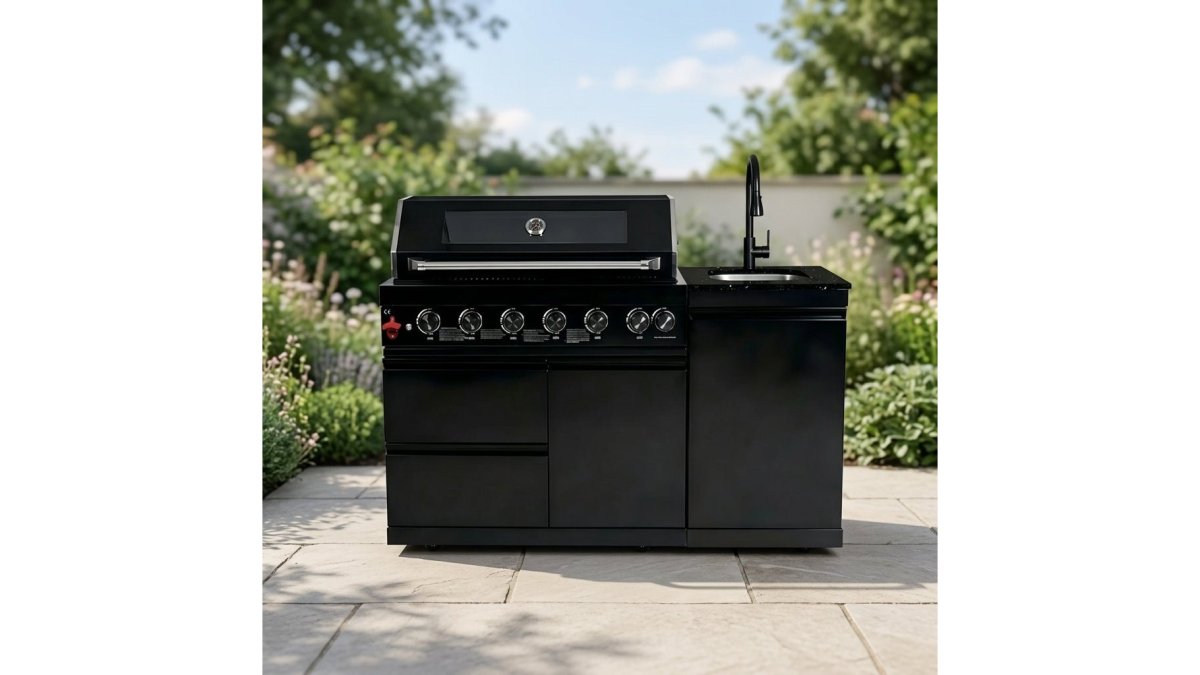
For a turnkey island, our outdoor kitchen planning resources walk through sizing and layout. Our own 63" 6-Burner Outdoor Kitchen Island Grill pairs an 85,000 BTU cooking system with a sink, refrigerator, and storage, so the whole station is one purchase.
Hybrid and Dual-Fuel Configurations
You do not have to choose. A gas island with a charcoal tray or a side burner gives you both. Some setups pair a gas grill with a separate charcoal kettle nearby, so you get smoke flavor when you want it and speed when you do not.
Total Cost of Ownership and Year-Round Weather Exposure
Charcoal looks cheaper at the register and costs more over time. You buy fuel every cook, replace grates more often, and spend hours on ash removal. Gas carries a higher upfront price but lower operating cost and less maintenance.
Weather exposure matters for both. Stainless steel construction resists corrosion and rust, which is why 304 stainless steel is the standard for permanent outdoor kitchens. Charcoal grills left in the rain rust faster and need covers. Gas islands built from 304 stainless steel hold up through winter with basic care.
| Cost Factor | Gas Grill | Charcoal Grill |
|---|---|---|
| Upfront cost | Higher | Lower |
| Fuel cost per cook | Lower | Higher |
| Maintenance | Grease tray cleaning | Ash removal, grate replacement |
| Weather durability | High with stainless steel | Needs cover and shelter |
Our 46" 4-Burner Outdoor Kitchen Grill with Side Burner is a compact entry point if you want a permanent gas station without a full-size island.
Conclusion
Choosing between gas and charcoal for an outdoor kitchen is really a question about how you cook and how permanent your setup is. Gas fits built-in islands, delivers precise heat control, and keeps operating costs down. Charcoal delivers smoke flavor and searing heat that gas has to work to match. Most households are best served by building around gas and adding charcoal as a secondary option.
At Home Outpost Supply, we stock outdoor kitchen islands built from 304 stainless steel, with features like infrared rear burners, integrated storage, and soft-closing hinges. Every order is tracked and insured, and our team is available before and after purchase. Browse our outdoor kitchen collection and add the right island to your cart.
Frequently Asked Questions
Is natural gas or propane better for a barbecue?
Natural gas is cheaper per BTU and never runs out because it connects to your home's supply, but it requires a permanent gas line and a licensed plumber or gas fitter to install. Propane heats faster, delivers slightly higher BTU output, and lets you move the grill, but you refill tanks and pay more per BTU. For a fixed outdoor kitchen, natural gas wins on long-term cost and convenience; for flexibility, choose propane.
Can you use a charcoal grill in an outdoor kitchen?
Yes, but only with a built-in charcoal grill designed for it and proper ventilation. Charcoal produces carbon monoxide, so the grill must sit in a non-combustible surround with clearances from combustible materials, and the area should be open or hood-vented. Check local codes before installing a charcoal grill under a roof or in an enclosed island. Many outdoor kitchens use a gas grill as the primary cooker and add a small charcoal grill for smoke flavor.
Does charcoal grilling taste better than gas grilling?
Charcoal produces more smoke and a distinct smoky flavor that many cooks prefer, especially for low-and-slow cooking and searing. Gas grills cook cleanly with little smoke unless you add wood chips or a smoker box. The flavor difference is real but not absolute: a gas grill with a smoker box or infrared sear zone can produce excellent results. Taste preference, not performance, usually decides this one.
Which grill is easier to use in an outdoor kitchen?
Gas grills are easier: push-button ignition, dial-in temperature control, and no ash cleanup. Charcoal requires lighting, fire management, and ash removal, which adds 20-30 minutes to a cook and leaves mess. For busy households, a gas grill built into the island is the lower-effort choice. Charcoal suits cooks who enjoy the process and want maximum smoke flavor.
The challenge is not picking a grill, it is building a cooking station that fits your patio, your fuel supply, and the way your family actually cooks. Home Outpost Supply carries outdoor kitchen islands with 304 stainless steel construction, integrated storage, and infrared searing, plus insured shipping and support before and after purchase. Get started with Home Outpost Supply and turn your patio into a cooking space that works year-round.


Leave a comment
This site is protected by hCaptcha and the hCaptcha Privacy Policy and Terms of Service apply.