


Article: Overhead Garage Storage vs Wall Mounted Racks: 2026 Guide
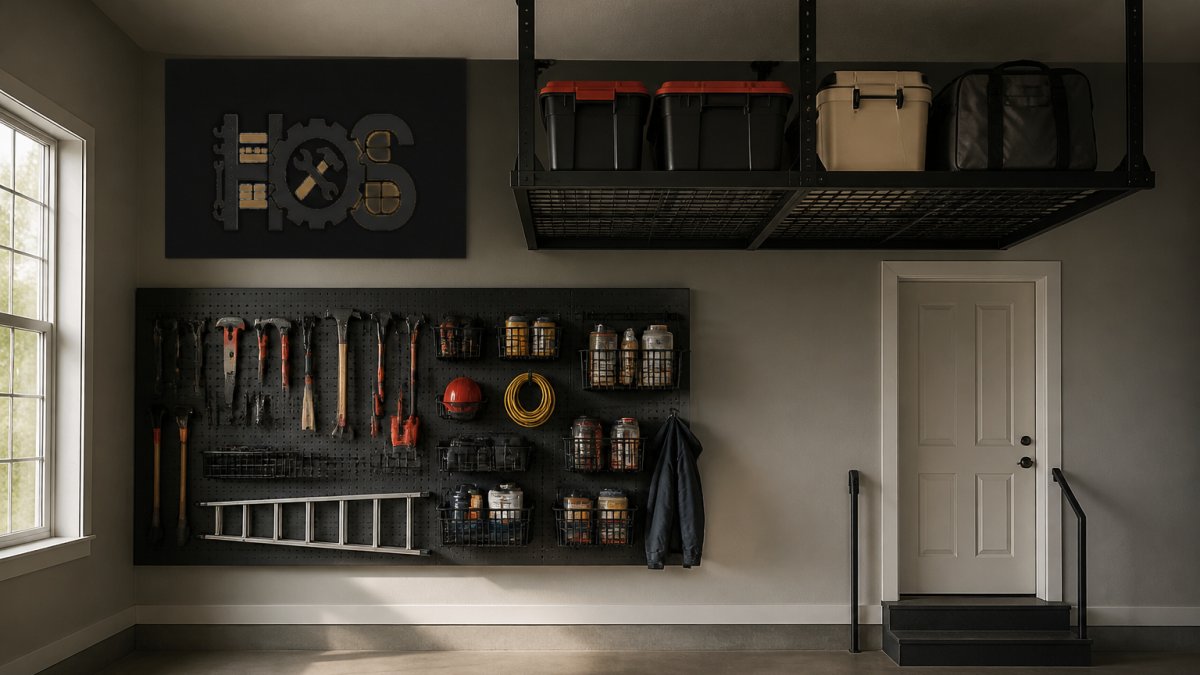
Overhead Garage Storage vs Wall Mounted Racks: 2026 Guide
Table of Contents
- Overhead Garage Storage vs Wall Mounted Racks: The Short Answer
- Side-by-Side Comparison: Ceiling Racks vs Wall Systems
- Garage Ceiling Storage Racks: What Goes Up and What It Costs
- Garage Wall Storage Systems: Shelves, Cabinets, and Racks
- Garage Storage Weight Capacity: What Each Type Can Actually Hold
- Garage Storage Installation: Structural Requirements and Real Costs
- Clearance, Ceiling Height, and Garage Door Mechanics
- Which One Fits Your Garage? Recommendations by Item and Access Frequency
- Frequently Asked Questions
Last Updated: October 19, 2026
Overhead Garage Storage vs Wall Mounted Racks: The Short Answer
Overhead garage storage wins when you need to clear floor space for vehicles and can reach the ceiling safely.
Ceiling space is abundant but awkward; wall space is convenient but limited. Overhead garage storage trades convenience for capacity.
Our recommendation: use both, but lead with the one that solves your biggest problem. Cars in the driveway? Go overhead first. Losing tools every week?
Side-by-Side Comparison: Ceiling Racks vs Wall Systems
Neither system is better in the abstract. They solve different problems, and the table below shows where each pulls ahead.
| Factor | Overhead / Ceiling Racks | Wall Mounted Racks & Shelves |
|---|---|---|
| Floor space used | None | None to minimal |
| Access speed | Slow, ladder or lift needed | Fast, grab and go |
| Best load type | Bulky, seasonal, light-to-mid weight | Tools, supplies, heavy dense items |
| Installation difficulty | High, needs ceiling joists | Moderate, needs wall studs |
| Ceiling height needed | Yes, plus door clearance | No |
| Visibility | Poor from the floor | Good |
| Typical price range | Higher | Lower |
| Best for | Bins, decorations, camping gear | Tools, paint, car care, hardware |
Overhead storage is a capacity play. Wall storage is an access play. Most garages need more of one than the other, and a few need both.
Garage Ceiling Storage Racks: What Goes Up and What It Costs
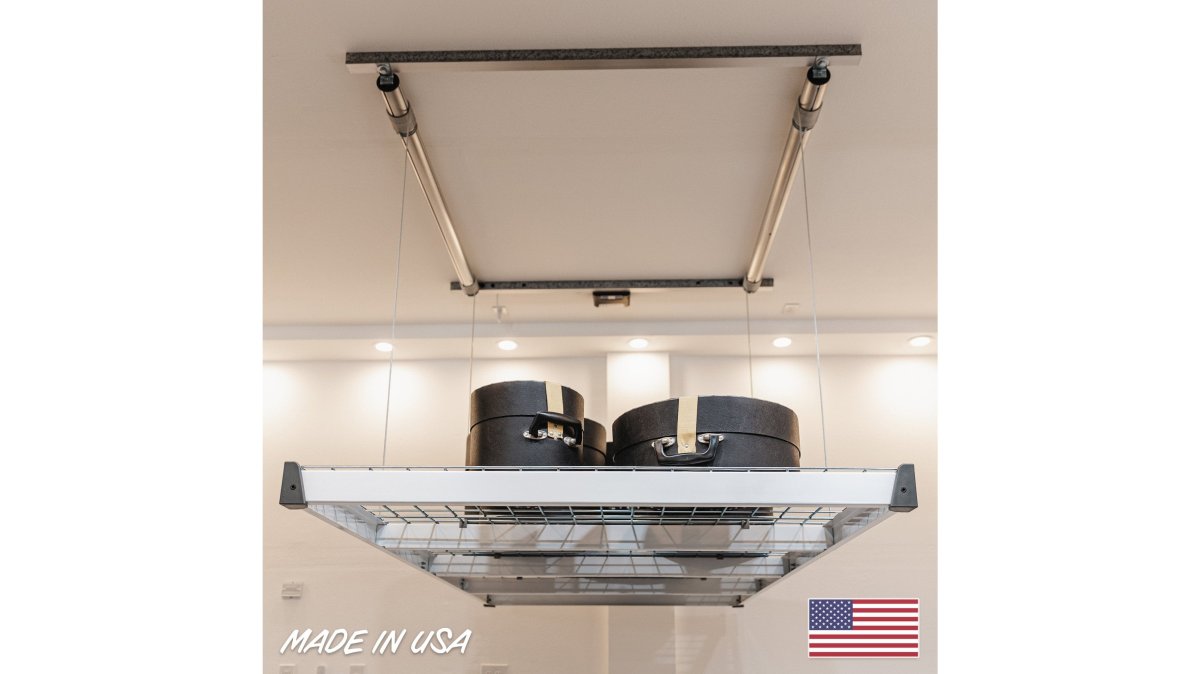
Garage ceiling storage racks are platforms suspended from ceiling joists that hold bins and bulky gear above the floor. They range from fixed racks you load with a ladder to motorized lifts that lower the platform to you.
A common mistake is buying a fixed rack, then realizing you cannot safely lift a 40-pound tote overhead from a step stool.
Fixed Ceiling Racks vs Motorized Lifts
Fixed racks are simple and cheap to own. You load them once or twice a season, and they disappear from daily life.
Motorized lifts solve that. The Auxx-Lift Storage Lift lowers the platform so you load at waist level and raise it with a remote.

The Attic-Lift is the 400 lb configuration at $3,125, built around a hot-dip galvanized steel mesh platform with vinyl-coated steel cables.
Garage Wall Storage Systems: Shelves, Cabinets, and Racks
Garage wall storage systems mount to wall studs and keep gear at eye level. They include open wire racks, closed cabinets, and heavy-duty shelving.
Closed cabinets suit messy-looking items and anything you want behind a door. The Nova Series Garage Cabinet Set C is a wall-mounted unit with extra-deep compartments, soft-close doors and drawers.

Open shelving suits heavy, bulky, or oversized items.
Garage Storage Weight Capacity: What Each Type Can Actually Hold
Weight capacity is where most buying decisions go wrong. The number on the box assumes proper installation, even load distribution, and correct anchoring. Miss any of those and the real limit is lower than the label.
Overhead systems vary widely. Motorized lifts are rated per configuration, from 400 lb up to 800 lb on the Auxx-Lift line. Fixed racks are usually rated lower.
| System | Listed Capacity | Real-World Limit |
|---|---|---|
| Motorized lift | 400-800 lb | Rated load, evenly spread |
| Fixed ceiling rack | Varies by model | Often lower than expected |
| Wall cabinet set | Light-to-mid | Per shelf, not per unit |
| Heavy-duty shelving | 7,200 lb total | 1,800 lb per tier, even load |
Garage Storage Installation: Structural Requirements and Real Costs
Installation separates a weekend project from a contractor job, and it is where most overhead-versus-wall decisions actually get made. Buy the system you can anchor safely.
What overhead racks need from your ceiling
Ceiling racks hang from the ceiling joists (the horizontal framing members above the drywall), not the drywall itself.
You also need to know what the joists are made of and which way they run.
Fasteners matter as much as the joist. Lag screws sized for the bracket (commonly 5/16- or 3/8-inch diameter, 3 to 4 inches long) are standard for wood joists.
What wall racks need from your walls
Wall-mounted cabinets and racks anchor into wall studs, typically 16 inches on center in framed walls and 24 inches in some older or garage-specific construction.
A common mistake is anchoring a heavy rack into drywall alone. Drywall holds almost nothing in tension. You need the stud or joist and the right fastener for the material. A stud finder, a level, and a pencil prevent most installation failures.
Tools and helpers
A basic install calls for a stud finder, a 4-foot level, a drill with driver bits, a socket set or nut drivers for lag screws, a tape measure, and a step ladder. Motorized lifts are DIY-friendly, but the platform and motor assembly are heavy and awkward, and the overhead work realistically needs two people. Cabinet sets are simpler but still need level mounting and solid stud contact.
Real cost ranges
Product price is only part of the number. A straightforward wall cabinet or shelving install a handy homeowner completes in an afternoon costs little beyond fasteners and a few tools. A motorized ceiling lift is a larger project: two people, several hours, and possible electrician work if a new outlet or circuit is needed near the ceiling. If you hire out, expect handyman or installer rates to add meaningfully, and get the quote after the installer has seen your joist layout, not before.
The single most important install decision is where you anchor. Find the joists or studs first, confirm their spacing and material, then choose the system that fits that spacing. Buying first and hunting for studs later is how projects stall.
Photograph your ceiling joists and wall studs with a tape measure in frame before you buy. The photo gives you the spacing, the direction, and the material in one shot, and it saves a second trip up the ladder.
Clearance, Ceiling Height, and Garage Door Mechanics
Clearance kills more overhead storage plans than any other factor, and most guides wave at it without doing the math. Here is the math.
The overhead clearance formula
Your usable overhead height is the floor-to-lowest-obstruction distance above the parking spot, minus the tallest vehicle's height, minus a safety margin. Work it in this order:
- Measure floor to ceiling at the spot where the rack will hang.
- Subtract the drop of the rack itself (the distance from the ceiling to the underside of the platform, typically 2 to 4 feet depending on the model and how high you raise it).
- Subtract the height of the tallest thing you will park underneath, plus a margin. A typical SUV or pickup is roughly 6 to 6.5 feet tall; a full-size van or lifted truck can exceed 7 feet. Use your actual vehicle, not an average.
- Subtract a working margin of at least 6 inches so a raised hood, an open liftgate, or a roof rack does not contact the platform.
If the result is negative, the rack cannot go over that parking spot. It can still go over a walkway, a workbench, or the area in front of the cars, where vehicle height is not a constraint.
Garage door travel and the opener rail
A sectional garage door does not go straight up. As it opens, the bottom panel swings inward and up along a curved track, then the panels travel back horizontally along the ceiling.
Measure the horizontal run of the door track and the position of the opener rail and its hanging brackets.
High-lift and side-mount openers change the geometry: a side-mount opener frees the center of the ceiling, and a high-lift track raises the horizontal run closer to the ceiling.
Wall-system clearance
Wall systems avoid most of this. Their constraint is horizontal: cabinet doors need swing room, and shelving needs depth clearance to reach the back. A 20.5-inch-deep cabinet needs that much clear floor in front, plus door swing. A wall rack over a workbench is fine as long as bench depth plus standing room does not put your head into the lowest shelf.
Do not trust a ceiling-height measurement taken at one spot. Garage ceilings slope, soffits drop, and the opener and door track sit lower than the drywall. Measure at the exact mounting point, and measure the lowest obstruction, not the highest point of the ceiling.
Overhead storage is a clearance problem before it is a storage problem. Run the formula, map the door's travel path, and confirm the opener rail location before you buy a rack. Wall storage trades that ceiling risk for a simpler horizontal clearance check.
Which One Fits Your Garage? Recommendations by Item and Access Frequency
Match the system to the item, not the aesthetic. That is the whole game.
- Seasonal decorations, camping gear, coolers, sports equipment: overhead. You touch these twice a year, so slow access costs you nothing. A motorized lift makes the twice-a-year trip painless.
- Tools, hardware, car care, paint, cleaning supplies: wall. You touch these weekly, so speed matters. Cabinets with soft-close doors keep them organized and out of sight.
- Heavy, oversized equipment and bulk totes: heavy-duty shelving. The WORKPRO unit handles the dense loads that cabinets and ceiling racks cannot.
If you are unsure, start with the access question. How often will you touch this item? Weekly means wall. Twice a year means overhead. Everything else is detail.
Frequently Asked Questions
Are wall-mounted garage racks better than ceiling racks?
Neither wins outright. Wall-mounted racks and cabinets suit frequently used tools and supplies because everything stays at eye level and within reach. Overhead garage storage works better for bulky, seasonal items you touch two or three times a year, especially when floor and wall space are already tight. Many garages end up using both: wall systems for daily tools, ceiling storage for holiday bins and camping gear. Decide by how often you need the item, not by which system looks stronger.
How much weight can wall-mounted garage racks hold?
It depends on the anchors and the wall. A wall-mounted cabinet set like the Nova Series carries tools and supplies, while heavy-duty shelving such as the WORKPRO 68-inch unit is rated for up to 7,200 lbs total and 1,800 lbs per tier when properly assembled and evenly loaded. The rack is only as strong as what it is fastened to, so anchor into wall studs or use appropriate masonry anchors, and follow the manufacturer's load distribution instructions.
Is overhead garage storage safe for heavy items?
Yes, when the rack is rated for the load and mounted correctly. Ceiling racks should be anchored to ceiling joists or a properly engineered support structure, never just drywall. Keep the heaviest items centered and distributed rather than concentrated in one corner. Motorized lifts like the Auxx-Lift are available in 400 lb, 600 lb, and 800 lb capacities depending on configuration, and they remove the ladder work that causes most overhead storage injuries.
How much does it cost to install overhead garage storage?
A motorized lift such as the Auxx-Lift Storage Lift starts at $2,389.00, and The Attic-Lift 400 lb model is $3,125.00. Fixed ceiling racks cost less up front but usually require ladder access and a helper. Wall cabinet sets run from $1,204.95 for the Nova Series Set C to $2,490.95 for the Astro Series 7-piece set. Professional installation is a separate cost and varies by market and structural work needed.
How do you choose between ceiling and wall-mounted garage storage?
Start with three measurements: ceiling height above your parked vehicles, available wall run, and the garage door's travel path. If you have at least 12 to 18 inches of clearance above an open door and mostly seasonal gear, ceiling storage frees the floor. If your walls are clear and you need daily access to tools, wall systems win. Then check garage storage weight capacity against what you actually own, and confirm garage storage installation requirements before buying.
Your garage does not need more square footage. It needs a system that matches how you actually use the space. Home Outpost Supply carries motorized lifts, wall cabinet sets, and heavy-duty shelving built for real garages, backed by insured shipping, secure payment processing, and a support team that answers before and after the sale. Add to cart and start with the one system that solves your biggest problem first.


Leave a comment
This site is protected by hCaptcha and the hCaptcha Privacy Policy and Terms of Service apply.