

Article: Is Shed Insurance Worth It? A Homeowner's 2026 Guide

Is Shed Insurance Worth It? A Homeowner's 2026 Guide
Table of Contents
- When Shed Insurance Is Worth It (and When It Isn't)
- What Homeowners Insurance Detached Structure Coverage Actually Pays For
- Does Homeowners Insurance Cover Shed Contents?
- How to Calculate Shed Replacement Cost Before You Call Your Agent
- What Standard Policies Exclude: Wind, Flood, and Wear
- Cheaper Than a Claim: Building a Shed That Survives the Storm
- Frequently Asked Questions
Last Updated: September 12, 2026
When Shed Insurance Is Worth It (and When It Isn't)
Shed insurance is worth it when the cost to rebuild your shed and replace what's inside it exceeds what your homeowners policy will pay on its own. This guide from Home Outpost Supply walks through the math most homeowners never run before storm season starts.
Here's the uncomfortable part. Most people assume their policy covers the shed out back. It usually does, but only up to a limit that's far lower than they expect. Below, we'll show you exactly how to check that limit, calculate your real exposure, and decide whether a separate policy or rider makes sense.
The Three Questions That Decide It
Three questions settle this faster than any calculator: How much is the shed worth, what does your policy already cover, and how likely is damage in your area?
If the replacement cost is low and your deductible is high, filing a claim rarely pays. If you're storing equipment worth more than the structure itself, the answer flips. The Insurance Information Institute's guide to homeowners insurance explains how deductibles apply to detached structures, and that detail alone changes the math for most people.
What Homeowners Insurance Detached Structure Coverage Actually Pays For
Homeowners insurance detached structure coverage pays to repair or rebuild structures on your property that aren't attached to the house, including sheds, garages, and fences.
That's the short version. The long version involves a percentage limit, and it's almost always tied to your dwelling coverage rather than a flat dollar figure.
The 10% Rule Most Homeowners Never Check
Most standard policies set detached structure coverage at around 10% of your dwelling limit. If your home is insured for $400,000, that's roughly $40,000 for every outbuilding combined.
Sounds generous until you add up a shed, a detached garage, and a fence. The National Association of Insurance Commissioners publishes consumer guidance on how these percentage limits work, and it's worth reading before you assume you're covered.
| Structure | Typical Coverage Source | What Triggers a Claim |
|---|---|---|
| Detached shed | 10% of dwelling limit | Wind, hail, fire, falling trees |
| Shed contents | Personal property limit | Theft, fire, storm damage |
| Fence or driveway | Same 10% bucket | Wind, vehicle impact |
| Flood damage | Separate policy required | Rising water, storm surge |
Does Homeowners Insurance Cover Shed Contents?
Homeowners insurance typically covers shed contents under your personal property limit, but that limit is shared with everything inside your house. A stolen mower competes with your furniture for the same pool of coverage.
Many homeowners find this out at the worst possible moment. The Federal Emergency Management Agency's flood risk resources also makes clear that standard policies exclude rising water, which matters if your shed sits in a low spot.
Why a $690 Shed and a $2,266 Shed Carry Different Risk
A cheap metal shed and a larger resin unit carry very different exposure, and the difference isn't just the sticker price.
Consider the spread across typical options:
- 13'x20' Metal Shed with Double Front Doors & Side Entry Door at $690.00. Low upfront cost, galvanized steel construction, and a footprint that holds lawn equipment and bikes. Replacing it out of pocket stings, but it won't wreck your year.
- 8x16Ft Resin Outdoor Storage Shed with Carpet at $2,266.95. Larger, weatherproof, and better suited to storing items you'd hate to lose.
- Outdoor Storage Shed 20x13 FT - Metal Garden Shed at $2,040.95. Heavy-duty galvanized steel with oversized double doors, sized for a workshop or vehicle.
A $690 structure rarely justifies a claim. A $2,266 structure with $3,000 of tools inside absolutely does.

How to Calculate Shed Replacement Cost Before You Call Your Agent
Replacement cost equals the price of an equivalent new shed plus the cost to clear the old one and rebuild the foundation. Estimate it before you call, so you're negotiating from facts.
Work through this checklist:
- Measure the shed footprint in feet and note the dimensions
- Find the current price of a comparable new unit
- Add site prep and foundation cost for your surface type
- Add delivery and assembly, or your own labor hours
- Total the value of everything stored inside
- Compare that total against your deductible and your 10% limit
If the total lands below your deductible, you're self-insuring whether you like it or not.
What Standard Policies Exclude: Wind, Flood, and Wear
Standard policies exclude flood, gradual deterioration, pest damage, and neglected maintenance. Wind and hail are usually covered, but often with a separate, higher deductible. The distinction that decides most shed claims is not what damaged the structure, it's whether the loss was sudden and accidental or the predictable end of a slow process.
Sudden Loss vs. Gradual Deterioration
Insurers pay for the first and deny the second. That single line explains almost every shed claim denial.
- Covered (sudden): a tree limb punches through the roof, a wind gust peels back a panel, hail dents the ridge, a fire starts from a faulty charger, a thief cuts a padlock and takes a mower.
- Excluded (gradual): rust that crept across a door frame over three winters, a floor that rotted because water pooled under it, a roof that sagged after years of leaf buildup, termites, and mold that grew from chronic condensation.
This is why the maintenance schedule below matters more than the policy language. An insurer inspecting a rusted-through panel sees wear, not damage. A homeowner sees the same panel and expects a check.
The Separate Wind and Hail Deductible
In many states along the Gulf and Atlantic coasts, and increasingly in hail-prone inland states, insurers apply a percentage deductible to wind and hail claims instead of a flat dollar amount. A 2% wind deductible on a $400,000 dwelling limit is $8,000 out of pocket before the policy pays anything on the shed. That number alone can make a claim pointless on a $690 structure.
Check your declarations page for two things: whether a separate wind/hail deductible applies, and whether it's expressed as a percentage or a flat figure. If it's a percentage, run the math before you assume coverage helps.
Flood Is Always Separate
Rising water, storm surge, overflowing creeks, sheet flow across a yard, is excluded from every standard homeowners policy. It requires a separate flood policy, typically through the National Flood Insurance Program or a private carrier. The Federal Emergency Management Agency's flood risk resources publishes flood zone maps and consumer guidance on what those policies do and don't cover. A shed sitting in a low spot that collects water after every heavy rain is a flood exposure, not a wind exposure, no matter how the damage looks afterward.
Pest, Mold, and Neglect Exclusions
Three more exclusions catch shed owners off guard:
- Pests. Termites, carpenter ants, rodents, and wildlife damage are excluded. Prevention is the only coverage.
- Mold and mildew. Usually excluded unless it traces directly to a covered sudden loss, and even then sublimits apply.
- Neglect. If the insurer can show you knew about a failing roof or a leaking seam and did nothing, the claim can be denied outright.
What This Means for the Buy-It-or-Skip-It Decision
If your shed is galvanized steel with an anti-UV coating, anchored to a proper foundation, and inspected twice a year, your realistic claim scenarios shrink to wind, hail, fire, and theft. Those are the risks worth pricing. If your shed is older, unanchored, or already showing rust, the exclusions will likely do more work than the coverage, and the money is better spent on maintenance than on a rider.
Cheaper Than a Claim: Building a Shed That Survives the Storm
The cheapest insurance is a shed that doesn't fail. Foundation preparation, anchor kits, and weatherproofing prevent more losses than any rider you can buy, and this is the part most shed guides skip entirely.
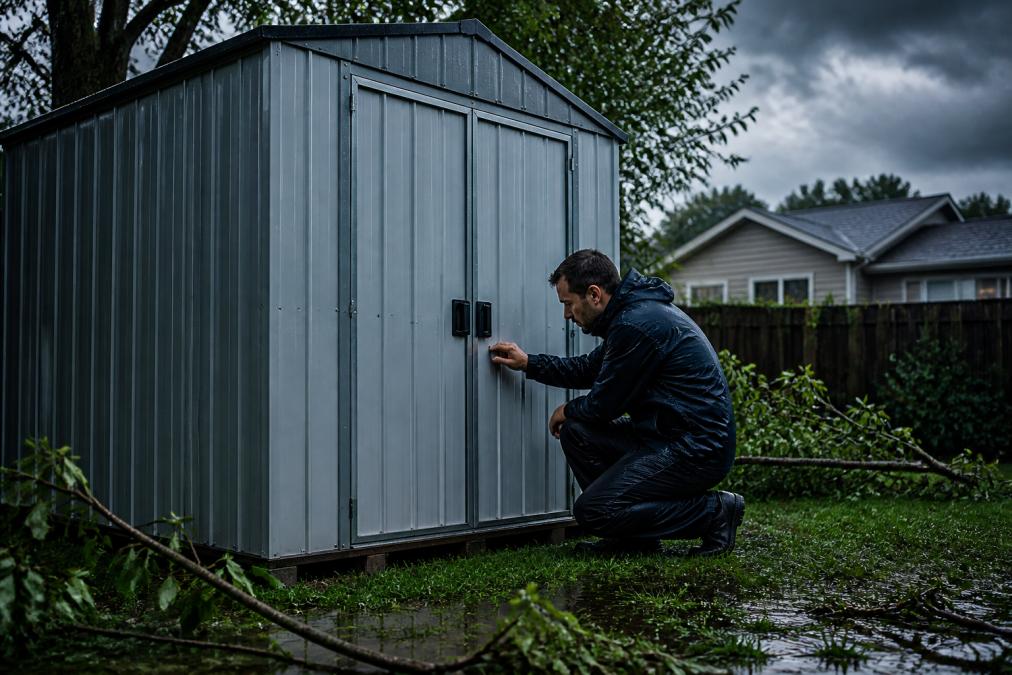
Foundation and Anchoring: The Failure Point Nobody Prices In
Most storm damage traces back to anchoring, not materials. A shed that lifts off its foundation in high wind wasn't secured properly, and no policy prevents that. The three foundation types behave very differently under load:
- Concrete slab. The most secure option. Anchor the shed's base rail to the slab with wedge anchors or expansion bolts. Best for heavy steel units and any shed that will hold high-value equipment.
- Gravel or crushed stone pad. Common and cheap, but anchors must be driven into the ground past the frost line or set in concrete footings at the corners. A shed sitting loose on gravel is a wind hazard.
- Wooden platform or skids. Portable and easy to level, but the wood itself becomes a rot and pest exposure. Use ground-contact-rated lumber and re-inspect annually.
Anchor kits are rated by wind zone. A kit rated for a 90 mph zone will not hold a shed in a 130 mph coastal zone, and the difference is visible on the packaging. Match the kit rating to your local wind zone, not to the shed's price tag. Auger-style earth anchors work in soil; concrete wedge anchors work in slabs; helical anchors work where soil is sandy or loose. Using the wrong anchor type is the single most common installation mistake.
Condensation Management: The Rust You Can't See
Condensation is the quiet killer of metal sheds. Temperature swings between day and night cause moisture to form on the underside of the roof and on cold wall panels, then drip onto whatever is stored below. Over a season, that moisture rusts tools, mildews cardboard boxes, and starts corrosion on the shed's own fasteners.
Three fixes, in order of effectiveness:
- Ventilation. Ridge vents, gable vents, or a solar-powered exhaust fan move humid air out. A shed with no ventilation will condense no matter how well it's sealed.
- Anti-condensation roof coating. A factory-applied or aftermarket drip-stop coating on the underside of the roof panel catches moisture before it drips. This is standard on better steel sheds and worth asking about.
- Vapor barrier on the floor. A plastic sheet under a gravel pad or between a slab and stored goods keeps ground moisture from wicking upward.
If you store anything with a motor, any fabric, or any paper product, condensation management is not optional.
A Seasonal Maintenance Schedule
'Low maintenance' does not mean 'no maintenance.' A metal shed that gets two inspections a year will outlast one that gets none by a decade or more. Here's the routine:
Spring (after winter):
- Walk the perimeter and check for frost heave, a foundation that shifted will show gaps at the base rail.
- Inspect the roof seams and ridge for lifted panels or missing screws.
- Re-tighten all bolts and screws; thermal cycling loosens fasteners over a winter.
- Check the door track and hinges for alignment.
Fall (before storm season):
- Clear leaves and debris from the roof and gutters; standing debris holds moisture against the metal.
- Inspect for rust spots and treat them immediately with a rust-inhibiting primer and matching touch-up paint.
- Re-check anchor bolts and earth anchors for corrosion or loosening.
- Confirm the padlock and door hardware are functioning; a jammed door after a storm becomes a water intrusion point.
Year-round:
- Keep the floor dry. Any standing water inside is a condensation or leak signal.
- Reapply lubricant to hinges and the door track once a year.
Customization That Also Protects
A few upgrades serve double duty, they make the shed look better and extend its life:
- Powder coating and UV-resistant paint slow surface degradation and hide the scratches that become rust starts.
- Shelving and wall-mounted racks keep stored goods off the floor, away from ground moisture and out of the way of foot traffic that dents panels.
- Padlock-compatible hasps and reinforced door frames deter break-ins, which is the one loss category where prevention directly replaces a claim.
Home Outpost Supply stocks sheds built around exactly these details, from compact resin units to heavy-duty galvanized steel models with double doors and side entry. Every order ships tracked and insured, so a damaged delivery doesn't become your problem.
Frequently Asked Questions
Does standard homeowners insurance cover outdoor sheds?
Most standard homeowners policies cover a detached shed under 'other structures' coverage, typically 10% of your dwelling limit. If your home is insured for $350,000, that gives you $35,000 for the shed and other detached structures combined. The catch: coverage usually applies to named perils like fire, hail, and vandalism, not gradual wear, rust, or neglect. Check your declarations page before assuming you're covered.
Are shed contents covered under my personal property insurance?
Yes, in most cases. Does homeowners insurance cover shed contents? Usually it falls under your personal property limit, which is often 50% to 70% of your dwelling coverage. That means the lawn mower, snow blower, and power tools stored in your shed are covered for the same perils as items inside your house. High-value items like a $2,000 generator may need a scheduled rider or a lower deductible to be fully reimbursed.
How does the replacement cost of a shed affect my insurance premiums?
A higher replacement cost raises the amount your insurer would pay after a loss, which can nudge your premium up slightly. On a detached structure endorsement, expect a small increase, often a few dollars per month for a shed in the $2,000 to $3,000 range. The bigger factor is your deductible. If your deductible is $1,000 and your shed is worth $690, filing a claim rarely makes sense.
Do I need a separate policy for a high-value storage shed?
Not always. If the shed's value sits under your other structures limit, your standard policy handles it. But if you've added insulation, electrical, a workbench, or expensive equipment, the combined value can exceed that cap. In that case, a scheduled personal property endorsement or a standalone policy closes the gap. Calculate shed replacement cost first, then compare it to your limit. That number tells you whether you need more coverage.
The hard truth is that most shed owners are either overinsured on a cheap structure or underinsured on an expensive one, and they only find out after a storm. Home Outpost Supply helps you get the structure side right first, with durable sheds, galvanized steel construction, and insured shipping on every order. Browse the shed lineup, pick a model sized to your yard, and add to cart with confidence.
The%20Three%20Questions%20That%20Decide%20It%0A%0A%0AWhat%20Homeowners%20Insurance%20Detached%20Structure%20Coverage%20Actually%20Pays%20ForThe%2010%25%20Rule%20Most%20...)
Leave a comment
This site is protected by hCaptcha and the hCaptcha Privacy Policy and Terms of Service apply.