


Double Truss Storage Shelter: The 2026 Buyer's Guide
Table of Contents
- Double Truss Storage Shelter Specs: What the Numbers Actually Mean
- Container Shelter Installation and Foundation Options
- Heavy Duty Fabric Shelter Wind Rating and Snow Load Capacity
- Single Truss vs. Double Truss: Which Frame Do You Need?
- PVC Fabric Shelter Maintenance and Weatherproofing
- Permitting, Zoning, and Total Cost of Ownership
- Conclusion: Choosing the Right Double Truss Storage Shelter
- Frequently Asked Questions
Last Updated: October 3, 2026
Double Truss Storage Shelter Specs: What the Numbers Actually Mean
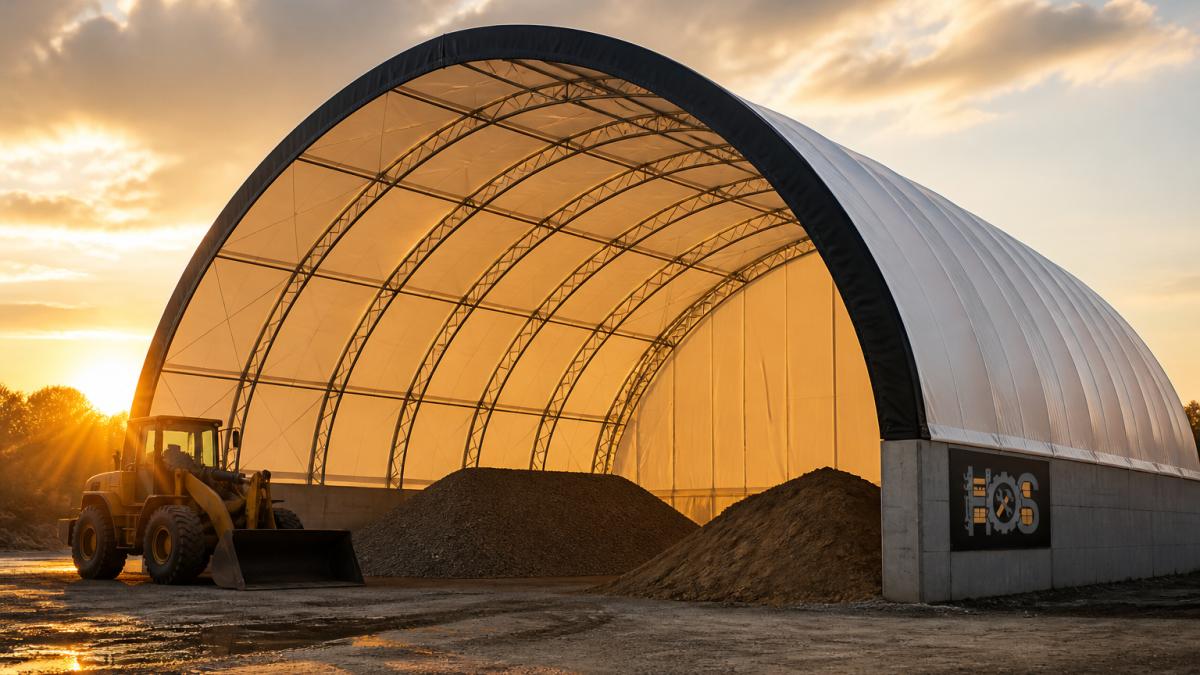
A double truss storage shelter is a fabric-covered structure built around two parallel steel truss arches per frame position, rather than one, which roughly doubles the frame's load-bearing capacity and rigidity. That design decision drives every other specification: steel gauge, arch spacing, fabric weight, and snow load. Below, we break down what each figure tells you about a double truss storage shelter, where the marketing language gets loose, and how to match a frame to your site.
Steel Tubing Gauge and Structural Durability
Gauge works in reverse from what most people assume: lower numbers mean thicker steel. A 15-gauge truss tube is heavier and stiffer than a 16-gauge tube, and that difference compounds across a 50-foot span where every arch carries roof load.
The Gold Mountain 50' x 80' Double Truss Commercial Storage Shelter uses 15-gauge hot-dip galvanized truss tubes with nine arches positioned roughly 10 feet apart.

PVC Canopy Weight and Fabric Specifications
Fabric weight, in ounces per square yard, determines how the canopy handles UV exposure, wind flutter, and puncture. Heavier PVC resists tearing and holds tension longer; lighter material costs less and sags sooner.
The Gold Mountain shelters in our catalog pair their frames with heavy-duty PVC canopies the manufacturer describes as both water-resistant and UV-resistant, the baseline you should demand.
Container Shelter Installation and Foundation Options
Container shelter installation comes down to one decision: mount the frame to shipping containers or anchor it to the ground. The right choice depends on whether you already own containers and how permanent you want the structure to be.
Pony Wall vs. Ground Mounting
Pony wall mounting sets the truss legs on top of shipping containers, raising clear span and adding lockable storage underneath. Ground mounting anchors the frame to concrete footings or ground anchors at grade level.
Heavy Duty Fabric Shelter Wind Rating and Snow Load Capacity
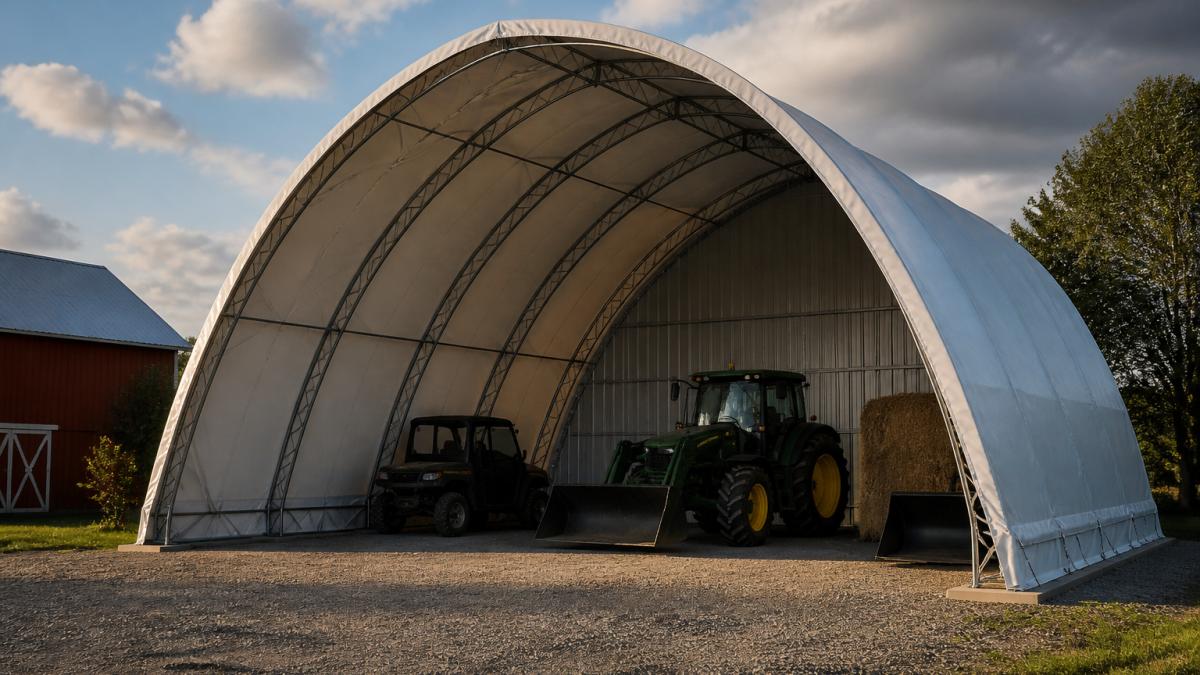
Snow load capacity, in pounds per square foot, should drive your purchase in a cold climate. The Gold Mountain 50' x 80' shelter carries a listed 48 lb./ft² snow load, and the 50' x 100' model uses the same double-truss, 15-gauge construction for comparable winter conditions.

Wind resistance works differently: fabric shelters shed wind by flexing slightly rather than fighting it rigidly, which is why the anchor system matters as much as the frame. A strong frame with weak anchors fails at the base plate.
| Specification | Gold Mountain 50' x 80' | Gold Mountain 50' x 100' |
|---|---|---|
| Footprint | 50' W x 80' L x 23' H | 50' W x 100' L x 23' H |
| Covered area | ~4,000 sq. ft. | ~5,000 sq. ft. |
| Frame | 15-gauge galvanized double truss | 15-gauge galvanized double truss |
| Listed snow load | 48 lb./ft² | Heavy-duty winter rating |
| Access | Two 18' x 16' roll-up doors | Large roll-up doors |
| Best for | Machinery, vehicles, inventory | Farms, equipment yards, warehouses |
Single Truss vs. Double Truss: Which Frame Do You Need?
Double truss suits significant span, snow, or wind loads; single truss suits smaller footprints and milder conditions.
A single truss frame uses one arched truss per position, lighter, less expensive, and adequate for a 20' x 30' shelter protecting a boat or garden equipment. The W20'xL30'xH12' Single Truss Arch Storage Shelter uses a 16-gauge galvanized frame and needs no foundation thanks to its stake peg system, making it genuinely portable.

Step up to a 50-foot clear span and the math changes: a double truss frame distributes load across two parallel trusses per arch, which is why commercial-scale buildings use it. The rule: if you need more than about 30 feet of clear span, or live where snow accumulates, choose double truss.
PVC Fabric Shelter Maintenance and Weatherproofing
PVC fabric shelter maintenance is mostly about tension, UV degradation, and moisture control, and takes less time than most owners expect. A heavy-duty fabric shelter wind rating depends on the canopy staying taut, so a loose cover undermines performance. The routine targets the three failure modes that end a canopy's life: tension loss, UV embrittlement, and trapped moisture.
How PVC Canopies Actually Fail
PVC canopy fabric is a polyester scrim laminated between PVC layers, with plasticizers for flexibility and UV stabilizers to slow sunlight damage. Three things degrade it:
- Plasticizer migration. Over years, plasticizers migrate out of the PVC, and the fabric stiffens and cracks at fold lines and attachment points. Heat accelerates this, so canopies in hot, sunny regions age faster.
- UV breakdown. Without intact UV stabilizers, the PVC surface chalks, the scrim becomes exposed, and the fabric loses tear strength. UV resistance is a baseline spec, not a premium one.
- Moisture and mildew. Water pooling in a slack canopy or sitting against the frame causes mildew staining and, over time, scrim rot. A taut canopy sheds water; a slack one holds it.
A Seasonal Maintenance Routine
Build the routine around the seasons, since failure risks change with the weather:
Gold Mountain 50' x 80' Double Truss Commercial Storage Shelter – 23' High →
- Spring: Inspect the full canopy for chalking, cracks, and abrasion where fabric meets frame. Re-tension the ratchet system, since winter wind and snow stretch the cover.
- Summer: Rinse the canopy to remove dust and debris that trap heat and moisture against the fabric. Check UV-exposed panels for color fade, an early sign of stabilizer depletion.
- Fall: Re-tension before snow season. Confirm the arch profile is clean so snow sheds rather than pockets. Inspect base plates and anchors for corrosion or loosening before freeze-thaw cycles.
Tensioning: The Single Highest-Impact Task
Tension matters most: a taut canopy sheds water and snow, resists wind flutter, and lasts longer, while a slack one does the opposite. Check tension at the ratchet system every season and after any major storm. If a ratchet slips or the strap frays, replace it before the canopy loosens further. A canopy slack for a season often needs a full re-tension, not a spot adjustment.
Cleaning and Small Repairs
Rinse the PVC canopy with water and mild soap to remove debris that traps moisture. Avoid abrasive cleaners, solvents, and pressure washers, which strip plasticizers and UV stabilizers. For small punctures or tears, PVC patch kits with the same fabric weight can extend canopy life by years if applied before the tear spreads. Larger tears or seam failures usually mean the canopy is near the end of its service life.
When to Replace vs. Repair
A canopy that is chalking, cracking at fold lines, or losing tension faster than before is telling you the plasticizers and UV stabilizers are depleted; patching it buys months, not years. The frame, by contrast, outlasts several canopy replacements, the real economy of a double truss shelter: you replace the cover, not the structure.
Permitting, Zoning, and Total Cost of Ownership
Permitting and zoning are the step most buyers skip until the shelter is delivered, and the one that most often turns a straightforward purchase into a months-long delay. Here is the framework to work through before you order.
Why Fabric Structures Trigger Permitting Questions
Many jurisdictions treat large fabric structures as accessory buildings, triggering setback rules, height limits, and permits. A 4,000-square-foot structure is not a garden shed to a planning office. Fabric shelters sit in a gray zone: not always permanent buildings, not always exempt as temporary structures. Classification often depends on size, anchoring method, and whether local code considers the structure permanent.
Questions to Ask Your Local Building Department
Before ordering, call your local building department and work through this list:
- Does this structure require a building permit, or is it exempt as a temporary or agricultural structure?
- What are the property's setback requirements, and does the shelter footprint fit within them?
- Are there height limits that the shelter's peak height would exceed?
Get the answers in writing if you can. A permit denial after delivery is far more expensive than a phone call before purchase.
Zoning Beyond the Building Department
Two other authorities can block a shelter the building department would approve. Homeowners associations frequently restrict outbuildings, fabric or otherwise, separate from municipal code. And in a floodplain, floodplain management rules may govern anchoring and elevation. Check both before assuming a permit is the only hurdle.
Total Cost of Ownership: Beyond the Sticker Price
Total cost of ownership runs well beyond the purchase price. A commercial-scale double truss storage shelter is a long-term asset, and the frame's 15+ year listed lifespan holds only if foundation and tensioning are done right. Budget for:
- Structure: frame and canopy, the visible sticker price.
- Foundation or anchoring: concrete footings, ground anchors, or shipping containers if you pony-wall mount. This is often the largest hidden cost.
- Site prep: leveling, grading, and access for delivery and assembly.
The Replacement Cycle Is the Real Economy
The frame and the canopy have very different service lives. A galvanized steel frame is built to outlast several canopy replacements, which means the canopy is a recurring cost, not a one-time one. When comparing a fabric shelter against a permanent building, weigh the lower upfront cost and faster installation against the recurring canopy replacement and the ongoing tensioning and inspection routine.
Conclusion: Choosing the Right Double Truss Storage Shelter
The hardest part of buying a double truss storage shelter is not the price; it is matching the frame, fabric, and foundation to your site and climate.
At Home Outpost Supply, we stock commercial-scale shelters built around those exact priorities, including the Gold Mountain 50' x 80' and 50' x 100' double truss models with 15-gauge galvanized frames and heavy-duty PVC canopies.
Frequently Asked Questions
What is the advantage of a double truss storage shelter?
A double truss frame uses two connected steel trusses instead of one, which increases load-bearing capacity and structural integrity across wider clear spans. This matters most for shelters 40 feet wide or larger, where snow load capacity and wind resistance become critical. The Gold Mountain 50' x 80' model, for example, lists a 48 lb./ft² snow load with 15-gauge galvanized steel tubes and nine arches spaced roughly 10 feet apart.
How much wind and snow load can a double truss shelter withstand?
Ratings vary by model, but double truss shelters generally handle higher loads than single truss equivalents because the dual-frame design distributes stress more evenly. The Gold Mountain 50' x 80' Double Truss Storage Shelter lists a 48 lb./ft² snow load capacity. Wind resistance depends heavily on your anchor system and installation quality. Proper ground mounting with base plates and ratchet tensioning on the PVC canopy keeps the structure stable in high winds.
Do I need a building permit for a large fabric storage shelter?
Permit requirements depend on your local jurisdiction, the shelter's square footage, and whether it qualifies as a temporary or permanent structure. Many areas require permits for structures exceeding 200 square feet or for anything classified as a permanent building. Fabric shelters on agricultural land sometimes qualify for exemptions, but rules vary by state and county. Check with your local planning office before ordering, and ask whether your shelter needs a foundation inspection or engineering certification.
What maintenance is required for PVC fabric shelters?
PVC fabric shelter maintenance focuses on keeping the canopy tensioned, clean, and free of snow buildup. Inspect the ratchet tensioning system seasonally and retighten as needed, since loose fabric flaps in wind and wears faster. Remove snow promptly to stay within the listed snow load capacity. Clean the PVC with mild soap and water to prevent UV degradation and mildew. Check galvanized steel connections for corrosion and tighten assembly hardware once a year.


Leave a comment
This site is protected by hCaptcha and the hCaptcha Privacy Policy and Terms of Service apply.