


7 Steps to Integrate a Pizza Oven Into Your Outdoor Kitchen
Last Updated: October 25, 2026
Quick Summary
To integrate pizza oven outdoor kitchen designs, position the oven where it serves as a centerpiece between your prep zone and seating area, ensure 3-4 feet of clearance on all sides, and connect it to grills and counter space at a standard 36-inch height. Plan your foundation, utilities, and ventilation before installation, and follow local building codes for permits and safety requirements.
- Most pizza ovens need 3-4 feet of clearance on all sides, though compact models work in tighter spaces at 23 inches wide
- Wood-fired ovens take 30-45 minutes to preheat while gas ovens heat up in 10-15 minutes
- Pizza oven foundations must be level within 1/8 inch over 10 feet to prevent cracking and uneven heat distribution
- Create at least 2-3 feet of counter space on each side of the oven for landing and prep space
- Wood-fired ovens require minimum 10 feet clearance from wood structures and 15 feet from vinyl siding
Table of Contents
- Plan Your Pizza Oven Outdoor Kitchen Layout
- Choose Between Wood-Fired or Gas Pizza Oven
- Design Your Pizza Oven Countertop and Base
- Meet Pizza Oven Clearance and Ventilation Requirements
- Integrate the Oven with Grills and Kitchen Cabinets
- Plan Utilities and Installation
- Build Your Outdoor Kitchen with Pizza Oven
- Avoid Common Installation Mistakes
- Frequently Asked Questions
Plan Your Pizza Oven Outdoor Kitchen Layout
When you integrate pizza oven outdoor kitchen designs, the first decision is where it goes. Placement shapes your workflow, safety, and how often you'll use the space. Getting it right isn't complicated.
Your layout needs to balance three things: how the oven fits your cooking workflow, whether people can see and interact with it, and whether the space functions when you're cooking. These goals work together.
Assess Your Available Space
Start by measuring what you have. Most pizza ovens need 3-4 feet of clearance on all sides, though compact models like the WPPO Karma 25" Compact 304 Stainless Steel Wood-Fired Oven work in tighter spaces at just 23 inches wide.

You also need to think about:
- How many people will gather around the oven
- Whether you want to prep food nearby
- How smoke will move across your yard
A pizza oven that dominates a small patio feels cramped; the same oven in a larger space can feel isolated from your seating area. Measure twice, visualize once.
Position the Oven for Visibility and Workflow
The best pizza oven location isn't hidden in a corner.
Think about your cooking workflow: where you'll prep ingredients, where guests will stand, and how people move from grill to oven to dining area.
Position the oven at a slight angle to your main entertaining area. This creates natural sightlines without making the oven the only thing to look at.
Choose Between Wood-Fired or Gas Pizza Oven
This choice shapes your entire outdoor kitchen. Wood-fired ovens deliver authentic flavor and theater.
Wood-fired ovens create that unmistakable smoky crust and the experience of managing a real fire.
Gas ovens heat up in 10-15 minutes and let you control temperature precisely.
Your choice also affects your outdoor kitchen layout.
Design Your Pizza Oven Countertop and Base
The oven itself is only part of the equation. The counters, base, and support structure determine whether your outdoor kitchen actually functions.
Select Your Foundation Type
Your pizza oven needs a rock-solid foundation. A shifting foundation cracks the oven and ruins your investment.
Most homeowners choose between three options:
- Concrete slab: Pour a 4-6 inch reinforced concrete pad. This is the most durable option and handles freeze-thaw cycles well.
- Pavers or stone: Lay pavers over a compacted gravel base. This looks better and drains water, but requires more maintenance and inspection over time.
- Raised deck or platform: Build a wooden or composite deck structure. This works if your ground slopes or drains poorly, but requires careful engineering to handle the oven's weight.
The foundation must be level. Use a laser level to check, since even small slopes cause uneven heat distribution and cracking. If your yard slopes, build up the lower side rather than digging down the higher side, which changes drainage patterns.
Choose Materials and Finishes
Stainless steel, stone, and brick are the standard choices, each with tradeoffs.
Stainless steel resists rust and looks modern, matching grills and refrigerators.
Stone and brick create warmth and visual interest. They age gracefully.
Mix materials strategically: stainless steel for appliances and storage, stone or brick for visual impact around the oven.
Meet Pizza Oven Clearance and Ventilation Requirements
This is where most DIY outdoor kitchens fail, creating fire hazards, smoke problems, or damaged structures.
Minimum Clearance Distances
Your pizza oven needs breathing room. The exact distances depend on whether you have a wood-fired or gas oven, and what's around it.
From the oven to combustible materials:
- Wood structures, fences, or overhangs: minimum 10 feet (wood-fired) or 5 feet (gas)
- Vinyl siding or plastic components: minimum 15 feet (wood-fired)
- Roof overhangs: minimum 12 feet clearance above the oven opening (wood-fired)
From the oven to people:
- Working space in front: minimum 3 feet
- Seating area: minimum 6-8 feet (to avoid heat and smoke)
- Traffic paths: minimum 4 feet on sides
These aren't suggestions. A pizza oven at 800-900 degrees radiates heat in all directions, so a wooden structure 8 feet away risks fire damage over time.
Ventilation and Smoke Management
Wood-fired ovens produce smoke. You need a plan for where it goes.
Install a chimney or vent hood above the oven opening to draw smoke up and away from people.
Position the oven so prevailing winds carry smoke away from your seating area and your neighbor's house.
Gas ovens produce less smoke but still need ventilation.
Integrate the Oven with Grills and Kitchen Cabinets
A pizza oven alone isn't an outdoor kitchen. It becomes one when connected to grills, storage, and prep surfaces.
WPPO Lava 40 Wood-Fired Pizza Oven with Convection Fan & Stand →
Combining Pizza Oven and Grill Stations
Position your grill 2-3 feet from the pizza oven to create a cooking zone for multiple dishes. A pizza cooks in 2-3 minutes, so you'll want to prep or cook other items while pizzas finish.
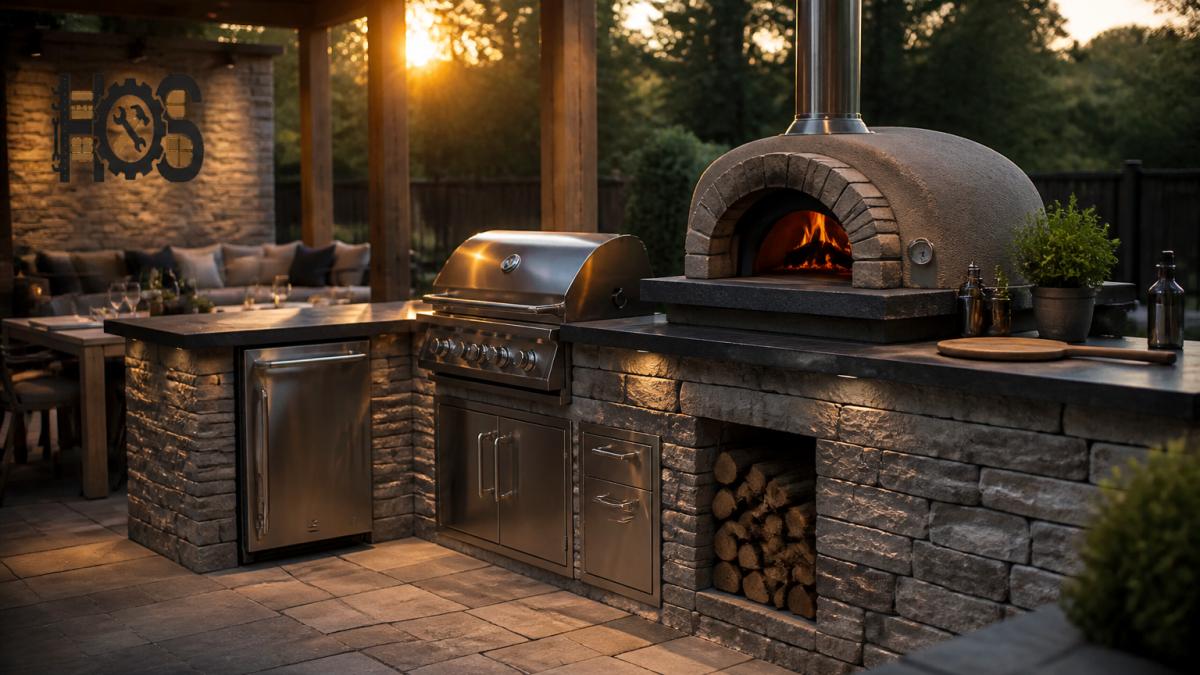
The grill should sit at the same height as the oven for visual continuity and easier workflow. Most designers align cooking surfaces at 36 inches high.
If you're adding a 4-Burner Grill as part of an 85" Outdoor Kitchen with Refrigerator & Sink, position it so you can move between the grill and oven without crossing paths with guests.
Adding Counter Space and Storage
Counter space is where outdoor kitchens succeed or fail. You need somewhere to set down a pizza peel, rest a plate, or hold ingredients.
Aim for at least 2-3 feet of counter space on each side of the oven for landing and prep space. A 20" Black Stainless Steel Outdoor Kitchen Sink Cabinet with Faucet provides both storage and a work surface, freeing up counter space for cooking.
The countertop height should match your grill and other appliances, typically 36 inches.
Storage matters too. Without cabinets, homeowners store pizza peels, tools, and serving pieces inside the house, breaking the workflow.
Plan Utilities and Installation
Before you build, know what utilities your outdoor kitchen needs and where they'll go.
Gas Line and Electrical Requirements
Gas lines are required for a gas oven or grill and must be installed by a licensed professional, with proper protection if buried or run through walls.
Electrical powers outdoor refrigerators, lighting, and some oven features. Bury conduit at least 18 inches deep in most areas, though local code may differ.
Both gas and electrical work require permits and inspections. Unpermitted work creates liability and makes your home harder to sell.
Building Permits and Structural Load
Most jurisdictions require permits for permanent outdoor structures. Check with your local building department first. Permits typically cover:
- Foundation and structural requirements
- Gas and electrical work
- Setback distances from property lines
Your outdoor kitchen also needs to handle weight. A pizza oven weighs 500-1,500 pounds; with countertops, cabinets, and a grill, you're looking at 2,000-4,000 pounds total.
On soil, compact it well and use a reinforced concrete base. On an existing patio or deck, verify it can handle the load.
Build Your Outdoor Kitchen with Pizza Oven
Now that you've planned, it's time to build. Browse outdoor kitchen products and systems to find everything you need for your installation.
Step 1: Prepare Your Foundation and Level Base
Pour or install your foundation first. If using concrete, let it cure at least 7 days before adding weight. Use a laser level to verify the surface is flat within 1/8 inch over 10 feet, since small slopes cause big problems later.
Mark the oven's final position on the foundation. Use chalk or spray paint. This ensures you position it correctly before installation.
Step 2: Install Your Pizza Oven and Structural Support
Position the oven on the foundation. Most ovens come with legs or a stand that distributes weight evenly; check that it sits level in all directions.
If you're building a custom stone or brick structure around the oven, this step takes longer. Leave proper clearance for airflow and maintenance, and ensure the structure supports the oven's weight and provides a finished appearance.
Step 3: Add Countertops, Cabinets, and Landing Space
Install countertops and cabinets around the oven. Stainless steel cabinets resist rust; stone countertops add visual appeal but require sealing.
Create landing space on both sides of the oven, at least 2-3 feet on each side. This is where pizzas rest before and after cooking.
Step 4: Connect Utilities and Test Systems
Have a licensed professional install gas lines and electrical connections, then test everything before use. Check gas lines for leaks with soapy water (bubbles indicate a leak) and test outlets with a multimeter.
Step 5: Finish with Weather Protection and Maintenance
Install a vent hood above the oven if you haven't already. Seal stone or brick countertops with an outdoor-rated sealer.
Plan for maintenance: wood-fired ovens need cleaning after each use, gas ovens need seasonal checks, and cabinets and countertops need annual sealing depending on material.
Follow these steps in order to build your outdoor kitchen with a pizza oven.
| Step | Action | Key Detail |
|---|---|---|
| 1 | Prepare foundation and level base | Let concrete cure at least 7 days before adding weight |
| 2 | Install pizza oven and structural support | Ensure oven sits level in all directions |
| 3 | Add countertops, cabinets, and landing space | Create at least 2-3 feet of landing space on each side |
| 4 | Connect utilities and test systems | Have licensed professional install gas and electrical |
| 5 | Finish with weather protection and maintenance | Seal stone or brick countertops with outdoor-rated sealer |
Avoid Common Installation Mistakes
Most problems come from skipping planning steps or rushing installation.
Mistake 2: Building on poor foundations. Settling foundations crack ovens and ruin countertops.
Mistake 4: Skipping ventilation. Smoke problems make outdoor kitchens unusable.
Mistake 6: Choosing materials that don't weather well. Cheap tile cracks. Unsealed stone stains.
Frequently Asked Questions
Can you build a pizza oven into an outdoor kitchen?
Yes. A pizza oven can be integrated into an outdoor kitchen through built-in or semi-built-in installation methods. Built-in ovens are set into cabinetry or masonry structures, while freestanding models sit on a countertop or base. Both approaches work; the choice depends on your space, budget, and whether you want a permanent installation or flexibility to relocate the oven later. Proper foundation, clearance, and utility planning are essential regardless of installation type.
How much clearance does an outdoor pizza oven need?
Most wood-fired and gas pizza ovens require a minimum of 10 feet of clearance from combustible materials like wood siding, deck railings, or tree branches. The cooking dome and chimney generate intense heat and smoke. Check your local fire codes and the oven manufacturer's specifications, as requirements vary by fuel type and oven design. Proper ventilation and clearance prevent fire hazards and ensure safe operation.
What materials are best for an outdoor kitchen pizza oven station?
Durable, weather-resistant materials work best. Stainless steel countertops and cabinetry resist corrosion and match most oven finishes. Stone or masonry construction (brick, tile, concrete) provides thermal mass and a finished appearance. For the oven itself, 304 stainless steel offers professional durability, while volcanic stone cooking surfaces provide authentic heat distribution. Seal or protect wood elements and use outdoor-rated hardware to withstand moisture and temperature swings.
What can you cook in a pizza oven besides pizza?
Pizza ovens are versatile. You can roast meats, bake artisan bread, prepare cast-iron dishes, grill vegetables and seafood, and bake desserts. The high, radiant heat works well for searing proteins, slow-roasting over coals, and baking with retained heat after the fire dies down. Wood-fired ovens create unique flavor profiles through smoke and direct flame contact, while gas models offer more temperature control for consistent baking.



Leave a comment
This site is protected by hCaptcha and the hCaptcha Privacy Policy and Terms of Service apply.