


Article: How Do You Choose Garage Cabinets for Heavy Tools?
How Do You Choose Garage Cabinets for Heavy Tools?
Last Updated: October 26, 2026
Quick Summary
To choose garage cabinets for heavy tools, weigh and group your tools by load first, then compare each shelf and drawer total to its stated rating and keep the combined load under the cabinet's overall capacity. Steel cabinets with ball-bearing full-extension slides and anchored, bottom-heavy loading hold heavy tools best.
- Group tools by weight class: light under 10 lbs, medium 10-25 lbs, heavy 25-60 lbs, very heavy 60+ lbs.
- If a cabinet lists no weight capacity, treat it as light-duty regardless of how sturdy it looks.
- Shelf load rating and drawer capacity are not interchangeable, so compare each to its own spec.
- Lag screws should penetrate the stud by at least 1-1/2 inches, with washers spreading the load.
- Anchor tall cabinets with anti-tip brackets and load the heaviest items at the bottom.
Table of Contents
- Start With a Tool-Weight Inventory, Not a Cabinet Catalog
- How to Calculate Garage Cabinet Weight Capacity for Heavy Tools
- Garage Cabinet Dimensions: Measuring Wall Space, Floor Area, and Depth
- Metal Garage Storage Cabinets vs. Wood: Which Holds Heavy Tools Better
- Wall-Mounted Garage Cabinets: Anchoring and Tip-Over Prevention
- Base, Tall, and Rolling Configurations for Heavy Loads
- Match a Cabinet System to Your Tool Load at Home Outpost Supply
- Frequently Asked Questions
Start With a Tool-Weight Inventory, Not a Cabinet Catalog
Most people shop for garage cabinets the way they shop for a couch: they find one they like, then hope it fits. With heavy tools, that order is backwards. Before you open a single product page, weigh what you actually own.
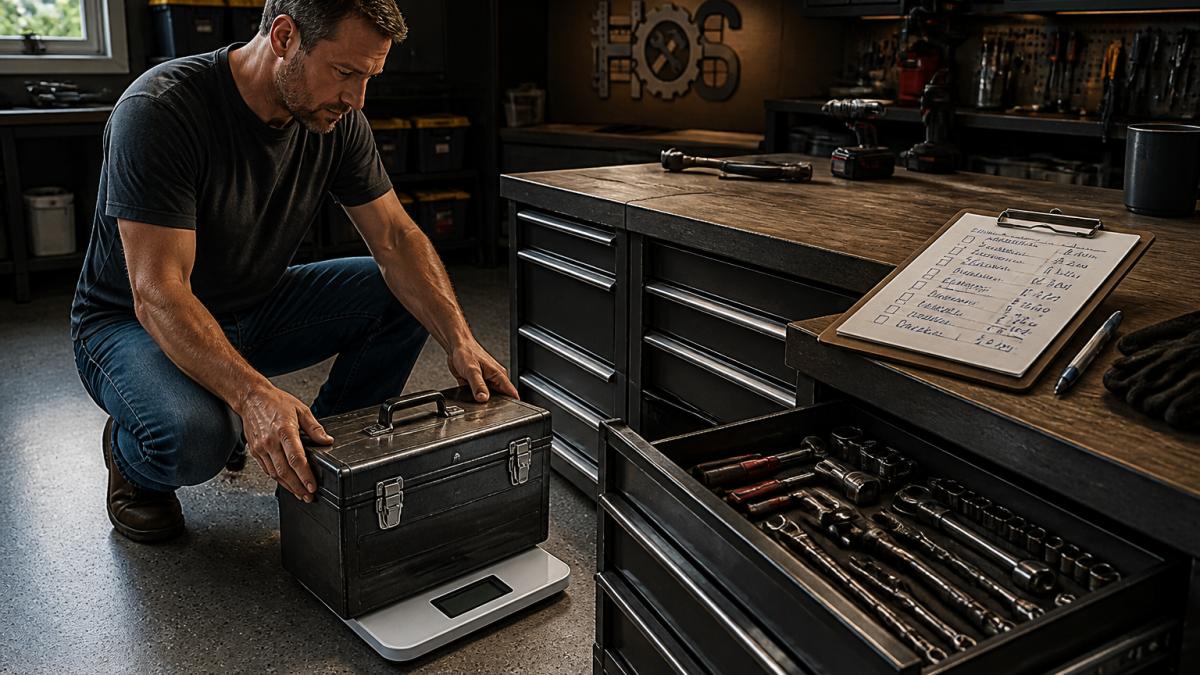
A simple inventory can help you plan. Grab a notebook and a bathroom scale, then work through the categories below.
Weighing Your Tools and Grouping Them by Load
Group tools by weight class, not by type. A drawer of sockets and a drawer of hammers look similar but stress the slides very differently.
- Light (under 10 lbs total): screwdrivers, pliers, measuring tools, small hardware.
- Medium (10-25 lbs): wrenches, sockets, power drill bodies, hand saws.
- Heavy (25-60 lbs): impact wrenches, circular saws, bench grinders, large socket sets.
- Very heavy (60+ lbs): vises, jack stands, engine components, bulk fastener bins.
Weigh a full drawer's worth at once. Stand on the scale holding the tools, then subtract your own weight. Write the number down. If you want a deeper look at decluttering before you commit to any purchase, our guide on why a better garage beats more tools walks through the reorganization first.
How to Calculate Garage Cabinet Weight Capacity for Heavy Tools
The safe load for a cabinet is the lower of two numbers: the shelf's rating and the cabinet's total capacity. Never stack heavy tools until the combined weight of every shelf and drawer stays under the cabinet's overall limit, with a margin left over.
Here is the calculation most buyers skip:
- Add the weight of every item going into one shelf or drawer.
- Compare that total to the shelf load rating or drawer capacity printed in the specs.
- Add up all shelves and drawers to get the total load.
- Keep the total at or below the cabinet's stated capacity.
If a cabinet lists no weight capacity, treat it as light-duty regardless of how sturdy it looks. Steel thickness and bracket design matter, but the rating is the only number you can trust.
Shelf Load Ratings vs. Drawer Capacity
Shelf load rating is the maximum weight a single shelf holds when that weight is spread evenly. Drawer capacity is the maximum weight one drawer holds on its slides. They are not interchangeable.
Drawers concentrate weight in a small footprint and rely on the slides, so a drawer rated for 99 lbs and a shelf rated for 200 lbs are doing different jobs. Heavy, dense items belong low and in drawers rated for them. Bulky but lighter items can sit on shelves.
Garage Cabinet Dimensions: Measuring Wall Space, Floor Area, and Depth
Measure three things before you buy: available wall space, usable floor area, and cabinet depth. Write each number down and subtract clearance for doors, drawers, and walking room.
Wall space decides how wide a run you can hang. Floor area decides whether a base or rolling unit fits without blocking car doors. Depth is the one people forget. A 30-inch-deep cabinet holds far more than a 20-inch one, but it also eats floor space and makes the back of a deep shelf hard to reach.
Standard garage cabinet dimensions vary widely, so check the actual listing rather than assuming. The Astro Series 7-piece set, for example, measures roughly 128 inches wide by 79 inches high by 20 inches deep, while the Homak HXL Pro cabinet runs 60 inches wide by 30 inches deep. Those two footprints solve very different problems.
Measure door swing and drawer pull-out too. A drawer that opens into your parked car is a drawer you will stop using.
Metal Garage Storage Cabinets vs. Wood: Which Holds Heavy Tools Better
For heavy tools, steel wins on load and longevity, but the reason is more specific than "steel is stronger." The right comparison is how each material behaves under concentrated weight, moisture, and the daily wear of slides and hinges in an unconditioned garage.
Homak HXL Pro Series 60" 10-Drawer Tool Storage Cabinet – Black →
Load Behavior: How Each Material Fails
Wood and melamine cabinets fail under heavy tools in predictable ways. Particleboard shelves bow between supports; MDF screw holes strip when a drawer slide pulls out under load; joints rack when a heavy drawer is yanked open.
Corrosion, Moisture, and Coating
Wood and melamine handle humidity differently: melamine resists surface moisture but swells at unsealed edges and seams, and particleboard loses strength permanently once it takes on water. In a garage with a damp floor or a history of condensation, sealed steel or stainless is the safer long-term bet.
Hardware Wear Under Heavy Load
Slides, hinges, and casters take the abuse in a heavy-tool cabinet. Ball-bearing full-extension slides hold up better than roller slides under dense loads; soft-close hinges reduce slam damage on tall doors; and casters on rolling units should be rated for the loaded cabinet weight, not the empty weight. Check that replacement slides and hinges are available, hardware is the first thing to wear out, and a cabinet you cannot re-harden becomes a shelf.
Wall-Mounted Garage Cabinets: Anchoring and Tip-Over Prevention
A loaded wall cabinet can weigh several hundred pounds, and a tall freestanding unit loaded top-heavy can tip with a single pulled drawer. Anchoring is not a formality, it is the difference between storage and a hazard. The good news is that the method is straightforward once you know where the load goes.
Find the Studs Before You Buy the Cabinet
For concrete or block walls, use masonry anchors rated for the load, sleeve anchors for solid concrete, and appropriate anchors for hollow block, and follow the cabinet manufacturer's fastener schedule. Do not substitute drywall anchors for structural fasteners on a loaded cabinet, no matter how the cabinet feels when empty.
Match Fasteners to the Load
Lag screws (commonly 1/4-inch or 5/16-inch diameter, long enough to penetrate the stud by at least 1-1/2 inches) are the standard for wood-framed walls. Washers spread the load at the cabinet back panel. For very heavy cabinets, a French cleat or a steel mounting rail distributes weight across multiple studs better than four corner screws. Always follow the manufacturer's specified fastener size and count, undersizing fasteners is a common shortcut that shows up later as a sagging cabinet.
Tip-Over Prevention for Tall and Freestanding Units
Tall cabinets and rolling units should be restrained against tip-over. Anchor tall cabinets to the wall with the supplied anti-tip bracket or strap, load the heaviest items at the bottom, and avoid putting dense tools in top drawers. Keep heavy drawers closed when not in use, and if the cabinet has a door lock, use it, a locked door keeps a loaded drawer from rolling open. For rolling cabinets, lock the casters before loading and before opening drawers, and consider a wall tether for units parked against a wall.
Floor Loading and Stability on Uneven Surfaces
A loaded cabinet is only as stable as the floor under it. Garage slabs often slope toward a drain, and that slope shifts the cabinet's center of gravity. Check for level with a spirit level front-to-back and side-to-side; shim the low corners with solid shims (not cardboard) and re-check before loading. On a sloped floor, place the cabinet so it leans slightly toward the wall rather than away, and anchor it regardless. For very heavy loads, confirm the slab can take the point load at the feet or casters, most residential slabs handle a loaded cabinet fine, but concentrated loads from small casters on a thin slab are worth a second look.
Base, Tall, and Rolling Configurations for Heavy Loads
The 19-drawer heavy-duty rolling tool cart has a listed capacity of up to 99 lbs per drawer and 5-inch wheels. The Homak 72-inch 16-drawer rolling tool cabinet offers 24,704 cubic inches of capacity.


| Configuration | Best For | Heavy-Load Note |
|---|---|---|
| Base cabinet | Dense tools, low lifting | Most stable, load bottom-heavy |
| Tall cabinet | Vertical storage | Anchor to wall, weight at base |
| Rolling cabinet | Mobile work | Lock casters before loading |
| Wall-mounted | Floor-space savings | Must hit studs or masonry |
Match a Cabinet System to Your Tool Load at Home Outpost Supply
The right system depends on your inventory and your space.
You can browse the complete garage storage systems lineup. The Nova Series Set C is a wall-mounted system with soft-close doors and drawers, and is described for organizing tools, automotive supplies, and other garage items. The HPDMC systems combine cabinets, drawers, pegboards, and workbenches; the listed HPDMC systems are constructed from cold-rolled steel.
Frequently Asked Questions
How much weight can garage cabinets hold?
The 7 ft Garage Workbench Cabinet lists 99 lbs per drawer, the 7ft Garage Storage Cabinet lists up to 110 lbs per drawer, and the Homak 72-inch rolling cabinet has 16 drawers and 24,704 cubic inches of total storage capacity.
Should heavy tools go in wall-mounted or freestanding cabinets?
Freestanding base and tall cabinets carry heavy tools better because the load travels straight down to the floor. Wall-mounted garage cabinets work well for lighter and frequently used items, but they transfer every pound to the wall structure, so they need proper anchoring into studs or masonry. For dense loads like vises, bench grinders, or full socket sets, put the weight low and keep wall cabinets for mid-weight storage.
Are metal or wood cabinets better for heavy tools?
The HPDMC 15-piece set is constructed from 100% cold-rolled steel, and the Astro Series uses E0-grade melamine board construction.
How do I anchor garage cabinets safely?
Fasten tall and wall-mounted units into wall studs or masonry with hardware rated for the cabinet's loaded weight, and follow the manufacturer's anchoring instructions. Keep the heaviest items in lower drawers and shelves to lower the center of gravity, and never load the top shelf first. For rolling cabinets, engage the locking casters before opening loaded drawers, and confirm the floor can support the combined cabinet and tool weight.
Choosing garage cabinets for heavy tools comes down to one discipline: know your load before you buy. Weigh your tools, measure your space, check the ratings, and anchor everything. Home Outpost Supply carries steel systems built for exactly this, with tracked and insured shipping, secure payment processing, and a support team that helps before and after purchase. Get started with Home Outpost Supply and build a garage where every heavy tool has a safe, stable home.


Leave a comment
This site is protected by hCaptcha and the hCaptcha Privacy Policy and Terms of Service apply.