


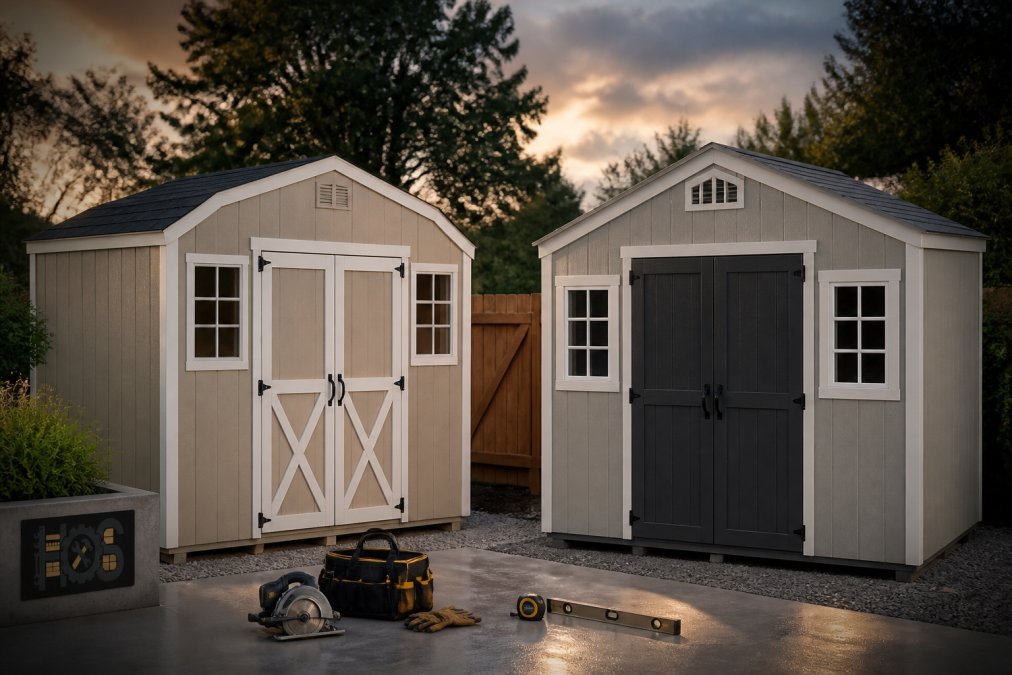
Home Depot vs Lowe's Sheds: Which Wins in 2026?
Table of Contents
- Home Depot vs Lowe's Sheds: Quick Comparison
- Prebuilt vs Built-on-Site Construction
- Resin vs Wood Storage Sheds: Material Durability
- Backyard Shed Permit Requirements and Zoning Compliance
- Cost of Professional Shed Assembly and Delivery
- Warranty Coverage and Customization Options
- Where Each Retailer Wins: Use-Case Recommendations
- Conclusion
- Frequently Asked Questions
Last Updated: September 14, 2026
Home Depot vs Lowe's Sheds: Quick Comparison
Neither retailer manufactures sheds. Both are resellers; your shed is built by a third-party manufacturer, shipped flat, and assembled on-site or delivered prebuilt by a local contractor. That fact explains nearly every difference in pricing, warranty, and installation quality. This guide from Home Outpost Supply breaks down the home depot vs lowes sheds comparison by construction type, material, permitting, and true cost of ownership.
Home Depot vs Lowe's sheds is not really a two-brand decision. It is a decision about construction method, material, and who handles the site work. Get those three right and the retailer logo matters far less than most buyers assume.
Winner: Home Depot for the widest in-store display and fastest curbside delivery. Choose Lowe's if you want a broader custom configurator and more flexible installation scheduling. Neither beats a specialty retailer on post-purchase support.
| Factor | Home Depot | Lowe's | Edge |
|---|---|---|---|
| Construction types | Prebuilt + kit assembly | Prebuilt + kit assembly | Tie |
| Material range | Resin, wood, metal | Resin, wood, metal | Tie |
| Foundation guidance | Basic | Basic | Tie |
| Permit help | None | None | Tie |
| Delivery | Curbside standard | Curbside standard | Tie |
| Installation | Third-party network | Third-party network | Lowe's |
| Warranty | Manufacturer-backed | Manufacturer-backed | Tie |
| Best for | Fast in-stock pickup | Custom configurations | Depends on need |
Prebuilt vs Built-on-Site Construction
Prebuilt sheds arrive fully assembled on a flatbed and are set with a forklift or crane. Built-on-site sheds ship as a flat kit, typically two to four packages weighing several hundred pounds each, and are assembled panel by panel. Prebuilt costs more upfront but eliminates the assembly weekend; the kit route saves money if you have time and a second set of hands.
What most guides miss is the access problem. A prebuilt shed needs a clear path at least as wide as the building for the truck and set-down equipment; fence lines, low branches, and sloped grading routinely kill prebuilt deliveries after the order is placed. Kit assembly sidesteps that because individual packages fit through a standard gate.
A common mistake is ordering a kit without confirming the unloading requirement. Many large metal and resin sheds ship on a pallet needing a forklift or liftgate; without one, the driver may leave the pallet at the curb and you will move hundreds of pounds by hand.
Consumer Product Safety Commission guidance on outdoor structure anchoring notes that unanchored outdoor structures present tip-over and wind-lift risks, which is why anchoring kits are included with most quality sheds and should never be skipped.
Resin vs Wood Storage Sheds: Material Durability
Resin sheds resist rot, insects, and moisture without painting or staining, while wood sheds offer superior structural rigidity and can be modified, insulated, and finished like a small building. The right choice depends on your climate, maintenance tolerance, and whether you plan to run power or climate control inside.
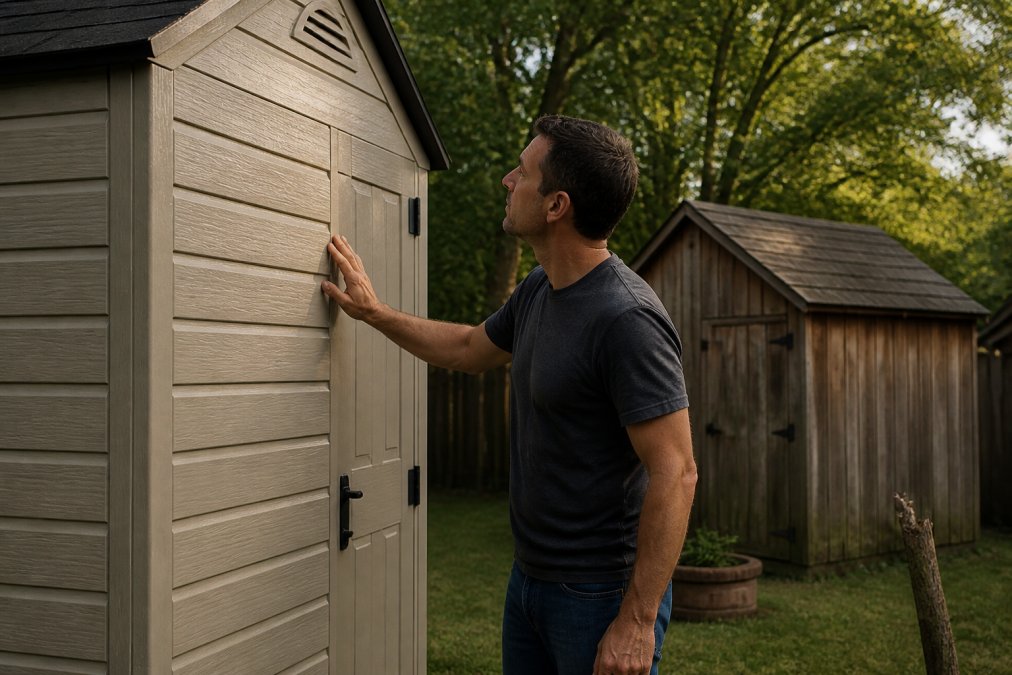
How Resin Sheds Hold Up
Resin storage sheds are molded from high-density polyethylene with UV inhibitors, which keeps color from fading and prevents the cracking cheaper plastics develop after freeze-thaw cycles. They handle wind-driven rain well because panels interlock rather than butt together. The trade-off is rigidity: resin walls flex, limiting how much weight you can hang on interior shelving, and most models cannot be insulated effectively.
Wood Sheds and Pressure-Treated Lumber
Pressure-treated lumber remains the standard for wood sheds because the treatment protects against termites and fungal decay, and it accepts paint or stain once dry. A wood shed with a moisture barrier under the floor and adequate ventilation will outlast most resin buildings, but it demands annual inspection of the roof, siding, and floor joists. Left unpainted, even treated wood weathers within a few seasons.

| Material | Maintenance | Weather Resistance | Modifiable | Best For |
|---|---|---|---|---|
| Resin | None | High | Low | Low-maintenance storage |
| Pressure-treated wood | Annual | High with upkeep | High | Workshops, insulated use |
| Metal | Low | High | Medium | Vehicles, large equipment |
Backyard Shed Permit Requirements and Zoning Compliance
Most jurisdictions require a building permit once a shed exceeds a set square footage threshold, commonly between 100 and 200 square feet, though the exact limit varies by municipality. Height, setback from property lines, and whether the structure sits on a permanent foundation also trigger review. Because these rules are local, confirm the numbers with your planning department before ordering.
Here is the part nobody tells you at the register: the retailer will sell you the shed regardless of whether it is legal on your lot. Zoning compliance is entirely your responsibility. A shed placed too close to a property line can result in a notice to remove it at your own expense.
Before you buy, pull your local zoning ordinance and check four things: maximum square footage allowed without a permit, required setback from each property line, maximum height, and whether a foundation base changes the classification. If your shed exceeds any limit, budget time for approval before scheduling delivery.
Cost of Professional Shed Assembly and Delivery
Professional shed assembly typically runs a few hundred to well over a thousand dollars depending on size, material, and site access, and is almost always quoted separately from the shed itself. Curbside delivery is the baseline for most online and big-box orders: the truck stops at the street or driveway edge and the rest is on you.
The cost of professional shed assembly breaks into four components:
- Delivery: curbside is standard; liftgate or inside placement costs extra
- Site prep: leveling, gravel pad, or concrete slab, priced by the square foot
- Assembly labor: scales with square footage and roof complexity
- Anchoring and finishing: ground anchors, door hardware adjustment, sealing
Here is the part most buyers only discover after ordering: the structure itself is often the smallest line item. A concrete slab or properly compacted gravel pad with a moisture barrier can rival the shed's own price at larger sizes, and skipping it causes doors to bind, floors to rot, and the structure to settle unevenly within a season or two.
What Each Line Item Actually Costs
Use these as planning ranges, not quotes. Your market, site access, and local labor rates will move the numbers.
| Line item | Typical range | What drives the price |
|---|---|---|
| Curbside delivery | Included to a few hundred dollars | Distance, whether a liftgate is required |
| Liftgate / inside placement | $75-$250 | Pallet weight, driveway clearance |
| Gravel pad (compacted, with weed barrier) | $4-$10 per sq ft | Depth of base, edging, drainage |
| Concrete slab | $6-$14 per sq ft | Thickness, rebar, finish, haul-away |
| Assembly labor | $300-$1,500+ | Square footage, roof pitch, panel count |
| Anchoring kit installed | $75-$300 | Wind rating required, anchor type |
A 10'x12' shed on a gravel pad with hired assembly commonly lands in the low four figures above the kit price. A 12'x20' wood shed on a poured slab with a complex roof can double the sticker price once site work is included. That is the real cost of ownership nobody puts on the shelf tag.
A Worked Example
Take a 13'x20' metal shed with double front doors and a side entry door listed at $1,599.00, with optional liftgate unloading for a $150 fee. That option matters: a 635 lb pallet cannot be safely hand-unloaded, and the fee is far cheaper than an injury or damaged panel. Add a compacted gravel pad at roughly 260 sq ft and you are looking at several hundred dollars in base material and labor before a single panel goes up; add anchoring and the true installed cost is meaningfully higher than the cart total.
For comparison, Home Outpost Supply lists a 13'x20' metal shed with double front doors & side entry door at $690.00, and a 12x20ft outdoor metal garage shed at $2,568.95 for vehicle and equipment storage. Every order is tracked and insured, which removes the delivery-damage argument, but the foundation math still applies no matter who ships the box.

Where the Money Actually Goes Wrong
The three most common cost overruns are predictable. Buyers underestimate site prep because they assume "level ground" means "ready ground", it rarely is. They skip the liftgate fee and then pay a crew to hand-unload a pallet never meant for it. And they buy before confirming permit requirements, then pay for a variance or relocation they did not plan for.
Get quotes for site prep and assembly before you order the shed, not after. A local installer who has seen your yard can price the foundation and labor in one visit, and that number should drive your size decision.
Warranty Coverage and Customization Options
Warranty coverage on big-box sheds is almost always the manufacturer's limited warranty, not the retailer's, covering defects in materials and workmanship rather than storm damage, settling, or improper installation. Read the exclusions before you buy, because "limited" usually means the retailer is out of the picture after delivery.
How Limited Warranties Actually Work
A limited warranty is a contract with the manufacturer, not the store. In practice that means three things:
- You file the claim, not the retailer. The store will usually hand you a phone number or a web form and step aside.
- Coverage is defect-only. Warped panels, failed hardware, and manufacturing flaws are typically covered. Wind lift, hail, snow load, and settling are not.
- Installation errors void coverage. If a panel cracks because the foundation was not level, the manufacturer will call it improper installation and deny the claim.
Most shed warranties run from a few years on resin and metal panels up to a decade or more on select wood and vinyl lines, but the term matters less than the exclusions. Photograph the pallet and every panel before signing the delivery receipt; shipping-damage claims are far easier to win with timestamped photos taken before the driver leaves.
Customization: What You Can and Cannot Change
Customization is where the two retailers genuinely diverge. Lowe's tends to offer a broader custom configurator with more options for door placement, window position, and siding color on select wood and vinyl lines, while Home Depot leans toward a fixed catalog of in-stock sizes with fewer build-to-order choices. Neither offers meaningful post-purchase modification support, so buyers who want to add shelving, run power, or insulate later should choose a structure with load-bearing capacity and accessible wall framing from the start.
Conversion-Ready Checklist: Turning a Shed Into an Office or Tiny Space
This is the step the big-box pages skip entirely. If you intend to work, sleep, or run equipment in the shed, the buying decision changes before you place the order.
- Wall framing you can open. Wood and metal stud walls accept insulation and outlets. Most resin panels do not, which rules resin out for conditioned space.
- Headroom and door width. Confirm interior height clears a standard door and that the entry is wide enough for a desk, chair, or equipment.
- Power path. Plan the trench or conduit run from the main panel before the foundation is poured, not after. Running power later means cutting or re-digging.
- Insulation and vapor control. A moisture barrier under the floor and a vented roof assembly prevent condensation that ruins electronics and drywall.
- Climate load. A space heater or mini-split needs a structure rated for it. Metal sheds without insulation sweat in winter and bake in summer.
- Permit classification. A shed used as habitable space may trigger different code requirements than a storage structure. Confirm before you build, not after.
If your goal is a workshop, office, or guest space, buy a wood or metal structure with accessible framing and plan the foundation, power, and insulation as one project. A resin storage shed is the wrong starting point for a conversion, no matter how good the warranty looks.

For buyers who want a shed that arrives with the configuration already sorted, Home Outpost Supply carries a 13'x20' metal shed with double front doors & side entry door at $690.00, plus a 12x20ft outdoor metal garage shed at $2,568.95 for vehicle and equipment storage. Every order is tracked and insured, which removes the delivery-damage argument entirely.
Where Each Retailer Wins: Use-Case Recommendations
Home Depot wins when you need a shed this weekend and the size you want is already on the floor: in-stock resin and metal kits, fast curbside pickup, and a nationwide store network make it the practical choice for straightforward storage. Lowe's wins when your yard demands a specific configuration and you will wait for a build-to-order unit with the door and window layout you want.
Neither wins if your priority is long-term durability paired with real post-purchase support. That is the gap specialty retailers fill. If you are buying a shed you intend to keep for fifteen years, the deciding factors are anchoring kits, foundation quality, and whether someone will answer the phone when a panel arrives bent.
- Choose Home Depot for speed, in-stock availability, and simple storage
- Choose Lowe's for custom configurations and flexible installation windows
- Choose a specialty retailer for insured shipping, liftgate options, and support after the sale
Conclusion
The hardest part of buying a shed is not choosing between two retailers. It is accounting for the foundation, the permit, and the delivery access neither store will manage for you. Home Outpost Supply stocks durable metal and resin sheds with insured shipping, tracked orders, and a support team that stays with you before and after purchase. Browse the 13'x20' metal shed line or the 12x20ft outdoor metal garage shed, add to cart, and get a structure that holds up season after season.
Frequently Asked Questions
Are Home Depot sheds good quality?
Home Depot sheds vary by brand and material. Their resin and metal options from makers like Lifetime and Suncast hold up well in most climates, while wood kits depend on the lumber grade. Quality also depends on assembly: a poorly built shed from good materials will underperform a well-built shed from average materials. Check the wind rating, warranty length, and whether a foundation base is required before buying.
What are the pros and cons of resin vs. wood sheds?
Resin sheds resist rot, insects, and moisture without painting or staining, making them largely maintenance-free. They cost more upfront and can fade or crack in extreme heat. Wood sheds, especially pressure-treated lumber, offer a traditional look and can be customized, but need regular sealing and are vulnerable to termites and moisture damage. Resin suits wet or humid climates; wood suits dry areas where you want to paint and modify.
Do Home Depot and Lowe's offer professional shed installation?
Both retailers offer installation through third-party contractors, but coverage and pricing vary by store and region. The cost of professional shed assembly typically ranges from a few hundred to over a thousand dollars depending on shed size, site access, and whether a foundation is needed. Always confirm whether the quote includes site prep, anchoring kits, and debris removal, since these are often billed separately.
What are backyard shed permit requirements?
Permit rules depend on your local municipality, not the retailer. Most areas require a building permit for sheds above a certain square footage, often 100 to 200 square feet, or taller than 10 feet. Homeowners associations may add stricter rules on setbacks, colors, and roof pitch. Check with your local building department and HOA before delivery, because a non-compliant shed may need to be moved or removed at your expense.
Who makes the best sheds for the money?
The best value depends on your priorities. For low maintenance and long-term durability, metal and resin sheds from established manufacturers offer strong cost-to-value ratios. For customization and a traditional look, pressure-treated wood kits win. Compare the total cost including foundation base, anchoring kits, delivery, and assembly, not just the sticker price. A $700 metal shed with a $300 foundation may cost less over 15 years than a cheaper wood shed needing annual upkeep.


Leave a comment
This site is protected by hCaptcha and the hCaptcha Privacy Policy and Terms of Service apply.