


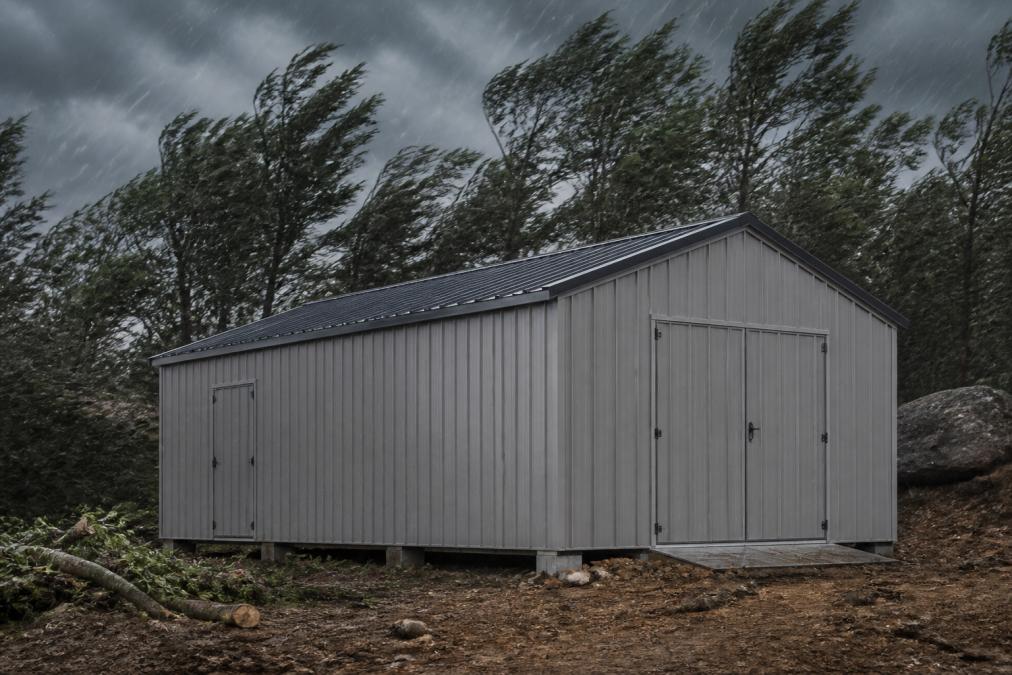
Best Shed for High Wind: A 2026 Buyer's Guide
Table of Contents
- What Makes a Shed for High Wind Actually Wind-Resistant
- Comparing the Best Sheds for High Wind Conditions
- Shed Anchoring Kits for High Wind: What You Need
- How to Reinforce a Shed for Hurricane Winds
- Building Code Requirements for Sheds in High-Wind Areas
- Professional Installation vs. DIY Assembly
- Conclusion
Last Updated: August 16, 2026
Choosing the best shed for high wind looks simple until a storm hits. At Home Outpost Supply, we've seen what separates a shed that survives a 70 mph gust from one that becomes a hazard. The difference comes down to three things: structural engineering, anchoring, and material quality.
What Makes a Shed for High Wind Actually Wind-Resistant
A shed for high wind resists both wind uplift (vertical pressure peeling the roof off) and lateral force (horizontal push trying to slide or tip the structure). Wind-rated sheds come with documented load specifications that take about five minutes to understand.
Wind Speed Ratings and mph Thresholds to Look For
Wind load ratings specify the maximum sustained wind speed a shed can handle before permanent deformation or failure. For most suburban areas, a minimum rating of 50 mph is baseline. Coastal zones, tornado corridors, and hurricane-prone regions need sheds rated for 90 mph or higher.
According to FEMA's guidance on wind-resistant construction, structures in high-wind zones should meet local building codes specifying wind loads in pounds per square foot (psf). A 90 mph wind produces roughly 20 psf of lateral pressure on a flat wall; a 130 mph hurricane-force wind can exceed 50 psf. Check the product spec sheet, not marketing copy.
Roof Pitch, Truss Systems, and Aerodynamic Design
A low-slope or flat roof catches wind like a sail. A steeply pitched gable roof deflects wind upward and reduces exposed surface area. Well-engineered trusses use triangulated bracing and heavy-gauge fasteners at every joint, distributing wind load across the full frame rather than concentrating stress at a few points.
Standing seam metal roofing outperforms corrugated panels in high-wind conditions because the raised seams interlock and resist wind uplift at panel edges. For zones with regular 60+ mph gusts, this detail matters.
Material Durability: Steel vs. Timber vs. Resin
Steel wins for wind resistance. A properly built steel frame with galvanized coating handles shear strength demands that timber and resin cannot match at comparable price points.
- Steel: Highest structural integrity, resists lateral force and uplift, rust-resistant with galvanized or powder-coated finish. Heavy gauge (14-gauge or 18-gauge) steel outperforms lighter sheet metal significantly.
- Timber frame: Good shear strength when properly braced, but susceptible to moisture damage over time and requires more maintenance.
- Resin/plastic: Lightest and easiest to assemble, but lowest wind resistance. Most resin sheds are not rated for sustained winds above 50 mph.
Comparing the Best Sheds for High Wind Conditions
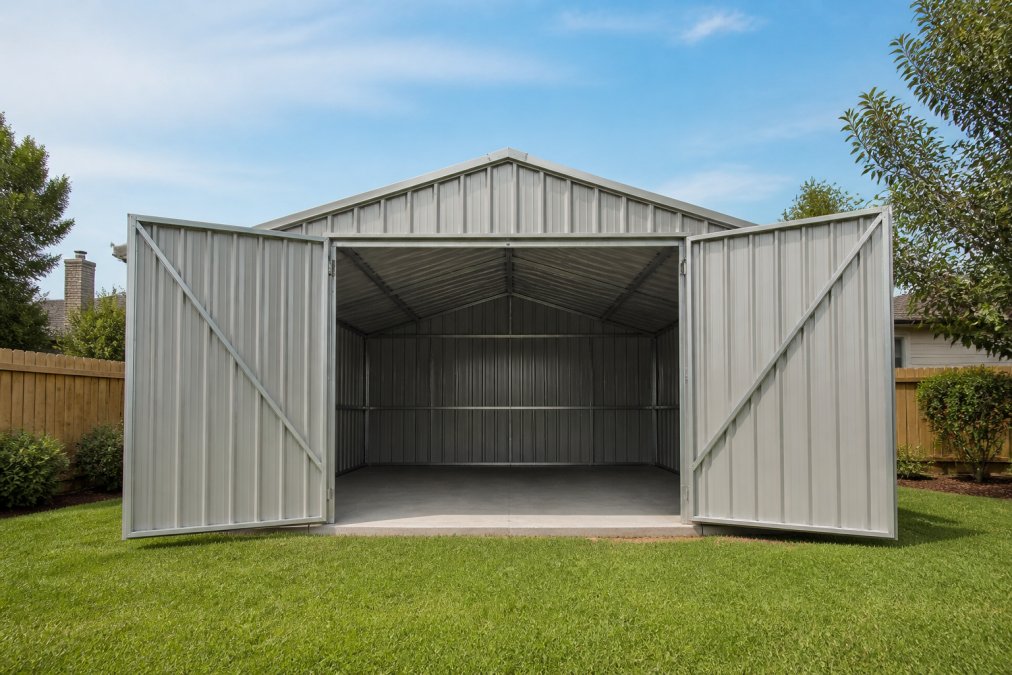
The sheds below represent options from Home Outpost Supply for homeowners prioritizing storm protection, with different strengths depending on space, budget, and wind exposure.
| Shed | Size | Frame Material | Wind Load Rating | Price |
|---|---|---|---|---|
| 10'x20' Plus Upgraded Metal Shed | 183.9 sq. ft. | Galvanized steel | 50 mph rated | $1,399.00 |
| 10x12 Steel Shed with Woodgrain Panels | 120 sq. ft. | Galvanized steel | Gable roof design | $1,807.67 |
| 20x12 Heavy-Duty Livestock Metal Shed | 240 sq. ft. | 14-gauge steel frame | Concrete anchor points | $2,701.95 |
| 12x9.8 Outdoor Storage Shed | 117.6 sq. ft. | Galvanized metal panels | Pitched roof, reinforced crossbars | $1,100.99 |
10'x20' Plus Upgraded Metal Shed
The 10'x20' Plus Upgraded Metal Shed carries a documented wind load rating of 50 mph and a snow load rating of 20 lbs/ft². The galvanized steel frame with sloped roof prevents water pooling and provides solid aerodynamic design. At 183.9 sq. ft., it handles full-size lawn equipment, bikes, and tools. The foundation requirement, concrete slab, solid wood, or equivalent, shows the manufacturer understands anchoring is part of wind resistance.

Best for: Homeowners who want a documented wind rating and space for a vehicle or large equipment.
10x12 Steel Storage Shed with Woodgrain Panels
The 10x12 Steel Storage Shed with Woodgrain Panels trades raw size for aesthetics without sacrificing structural quality. The raised gable roof deflects wind and increases interior headroom. The galvanized steel frame resists rust and rot. Wide double doors provide convenient access without creating large unsupported wall spans.

Best for: Suburban homeowners who want wind-resistant performance with a residential appearance.
20x12 Heavy-Duty Livestock Metal Shed
The 20x12 Heavy-Duty Livestock Metal Shed is built to a different standard. The 14-gauge 2.3" square-tube frame paired with 26-gauge metal panels provides significantly higher shear strength than lighter-gauge competitors. The skid-mounted base with pull eyelets and 6" × ½" concrete anchors is included, meaning anchoring hardware isn't an afterthought.

Best for: Rural properties, coastal zones, or anyone needing maximum structural integrity.
12x9.8 Outdoor Storage Shed with Pitched Roof
The 12x9.8 Outdoor Storage Shed is the entry-level wind-capable option. Galvanized metal panels, a pitched roof that promotes water runoff, and reinforced crossbars make this a solid performer for moderate wind zones. At $1,100.99, it's the most accessible price point for basic storm protection.
Best for: Homeowners in moderate wind zones (under 60 mph) needing affordable, weather-resistant storage.
Shed Anchoring Kits for High Wind: What You Need
A structurally sound shed that isn't anchored will still become a projectile in a serious storm. Shed anchoring kits for high wind are not optional in any region seeing sustained winds above 50 mph.
Concrete Slab and Foundation Bolting
Foundation bolting to a concrete slab is the gold standard for wind resistance. Anchor bolts embedded in a poured concrete slab before it cures are bolted directly to the shed's base plate, creating a rigid connection resisting both uplift and lateral force. The concrete slab should extend at least 4 inches beyond the shed's footprint on all sides, with bolts at 24-inch intervals along the perimeter.
Ground Anchors and Auger-Style Systems
Ground anchors and auger-style systems are practical alternatives for existing sheds or installations on grass, gravel, or compacted soil. Auger-style anchors screw into the ground using a helical blade, resisting pull-out force significantly better than simple stake anchors. Soil type matters: sandy or loose soil requires longer auger anchors (36 inches or more), while clay or compacted gravel provides better resistance with shorter anchors.
Hurricane Straps and Fasteners for Existing Sheds
Hurricane straps are metal connectors that tie the roof structure to the wall framing. They're the standard solution for retrofitting wind resistance to an existing shed. The straps wrap around or bolt to roof trusses and attach to wall studs or frame below, creating a continuous load path from roof to foundation.
For metal sheds, use straps rated for the specific gauge of steel in your shed. Use self-tapping screws rated for the metal thickness, and add structural bracing at corners where lateral force concentrates. According to the Insurance Institute for Business & Home Safety's wind mitigation resources, continuous load path connections from roof to foundation are the single most effective retrofit for reducing wind damage in accessory structures.
How to Reinforce a Shed for Hurricane Winds
Reinforcing an existing shed for hurricane winds is a realistic DIY project. The goal is to create a continuous load path: wind force transfers from roof panels through trusses, down wall framing, and into foundation anchors without weak connections breaking the chain.
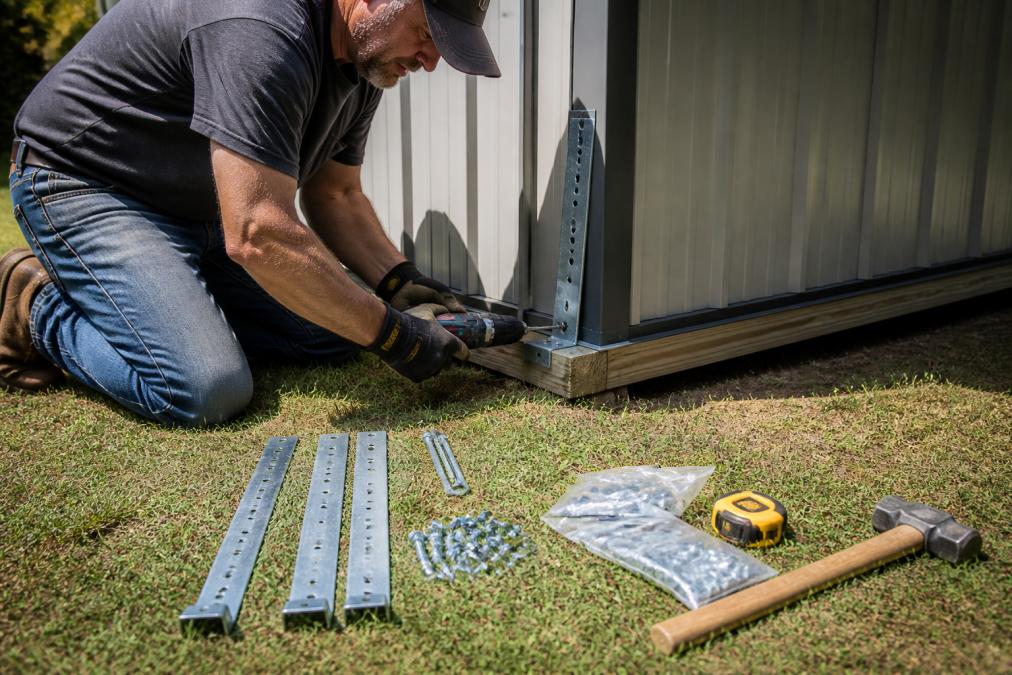
Structural Bracing and Steel Reinforcement
The most common failure point under wind load is the corner connection between wall and roof. Adding steel angle brackets at each interior corner significantly increases shear strength. For larger sheds, diagonal cross-bracing on interior walls prevents racking, the sideways deformation that happens when lateral force exceeds frame stiffness. For metal sheds, 18-gauge steel reinforcement plates at bolt connections prevent fasteners from tearing through panels under load.
Door and Window Hardware for High-Wind Zones
Doors and windows are the most common entry points for wind pressure. Upgrade door hardware with heavy-duty barrel bolts or flush bolts at the top and bottom of each door panel. For double doors, add a center post that locks into the floor and header. This prevents doors from flexing inward under wind pressure.
Windows should be covered with storm shutters or reinforced with security film during high-wind events. The film prevents glass from shattering and depressurizing the shed interior, which dramatically increases uplift force on the roof.
Coastal vs. Inland Wind Considerations
Coastal zones face wind threats fundamentally different from inland areas. Salt air accelerates corrosion on metal fasteners and frames. Inland tornado corridors face shorter-duration but more intense wind events. Coastal homeowners should prioritize powder-coated frames, stainless steel fasteners, and regular inspection of metal connections. Inland homeowners in tornado zones should prioritize heavy anchoring and interior cross-bracing over surface finish.
Building Code Requirements for Sheds in High-Wind Areas
Building codes for sheds vary by jurisdiction, but underlying engineering standards are consistent. Understanding the framework helps you buy the right shed and avoid costly permit violations.
Permits, Wind Load Standards, and PSF Ratings
Most jurisdictions require a building permit for sheds above a certain size, typically 120 square feet or larger. The permit process involves submitting plans demonstrating the structure meets local wind load requirements, expressed in psf.
The American Society of Civil Engineers' ASCE 7 standard defines wind load design requirements that most local building codes reference. ASCE 7 maps the country into wind speed zones and specifies the design wind pressure every structure must withstand. Check with your local building department before purchasing.
Insurance Implications of Wind-Rated Sheds
A shed that isn't permitted or doesn't meet local wind load standards may not be covered by your homeowner's insurance policy if damaged in a storm. Many homeowner's insurance policies cover accessory structures up to a percentage of dwelling coverage, but coverage often requires the structure to be built to code. An unpermitted shed damaged in a hurricane may result in a denied claim. Pull the permit, use a wind-rated shed, document installation with photos, and notify your insurance carrier that you've added an accessory structure.
Professional Installation vs. DIY Assembly
DIY assembly is realistic for most sheds in this guide. Two people can complete most assemblies in a weekend. Professional installation makes sense for concrete slab preparation, deep auger anchor installation in difficult soil, and any shed over 200 sq. ft. in a high-wind zone.
A common mistake is treating assembly as the hard part and anchoring as an afterthought. The opposite is true. A shed assembled in a day and anchored poorly will fail. A shed assembled over a weekend with proper foundation work will stand for decades.
Storm season doesn't wait for the right moment to test your storage setup. Home Outpost Supply carries a curated selection of wind-rated steel sheds, from the entry-level 12x9.8 pitched-roof model to the heavy-duty 20x12 livestock shelter with built-in concrete anchor points. Every order ships with tracking and insurance, and the support team is available before and after purchase to help you match the right shed to your wind zone and anchoring requirements. Add to cart and get your property storm-ready before the next system rolls in.
Frequently Asked Questions
Are metal sheds better than wood sheds for high winds?
Generally, yes. Steel and galvanized metal sheds outperform wood in high-wind conditions because they resist warping, splitting, and rot that weaken timber frames over time. Heavy-gauge steel panels and powder-coated frames maintain structural integrity under lateral force and wind uplift. Timber sheds can perform adequately when properly braced and anchored, but they require more maintenance to stay wind-resistant. For storm-prone regions, a steel shed with a rated truss system and proper anchoring is the more reliable long-term choice.
How do I anchor a shed to a concrete slab for high winds?
Foundation bolting is the most secure method. Drill anchor holes through the shed's base rail into the concrete slab, then install expansion anchors or J-bolts rated for your local wind load requirements. Pair this with hurricane straps connecting the wall framing to the floor plate. For sheds without a concrete slab, auger-style ground anchors driven at an angle into firm soil provide meaningful resistance to wind uplift. Check your local building code for minimum anchor spacing and fastener specifications before starting.
Do I need a building permit for a wind-resistant shed?
Permit requirements vary by jurisdiction, but many counties and municipalities require a permit for any permanent structure, including sheds above a certain square footage, commonly 100 to 200 square feet. In high-wind or coastal zones, building departments often mandate that sheds meet specific wind load ratings measured in pounds per square foot (psf). Skipping a permit can affect your homeowner's insurance claim if the shed is damaged in a storm. Contact your local building department before purchasing to confirm what applies to your property.
What wind speed rating should I look for in a shed?
The right rating depends on where you live. Most standard sheds are rated for winds up to 50 mph, which suits low-risk inland areas. Regions prone to severe thunderstorms typically need sheds rated for 90 mph or higher. Coastal and hurricane-zone homeowners should look for structures rated at 110 mph or above, with building code compliance for their specific wind zone. Always check the manufacturer's stated wind load rating before purchasing, and verify it aligns with your local requirements under the International Residential Code or your state's adopted building standards.
This article was written using GrandRanker


Leave a comment
This site is protected by hCaptcha and the hCaptcha Privacy Policy and Terms of Service apply.