


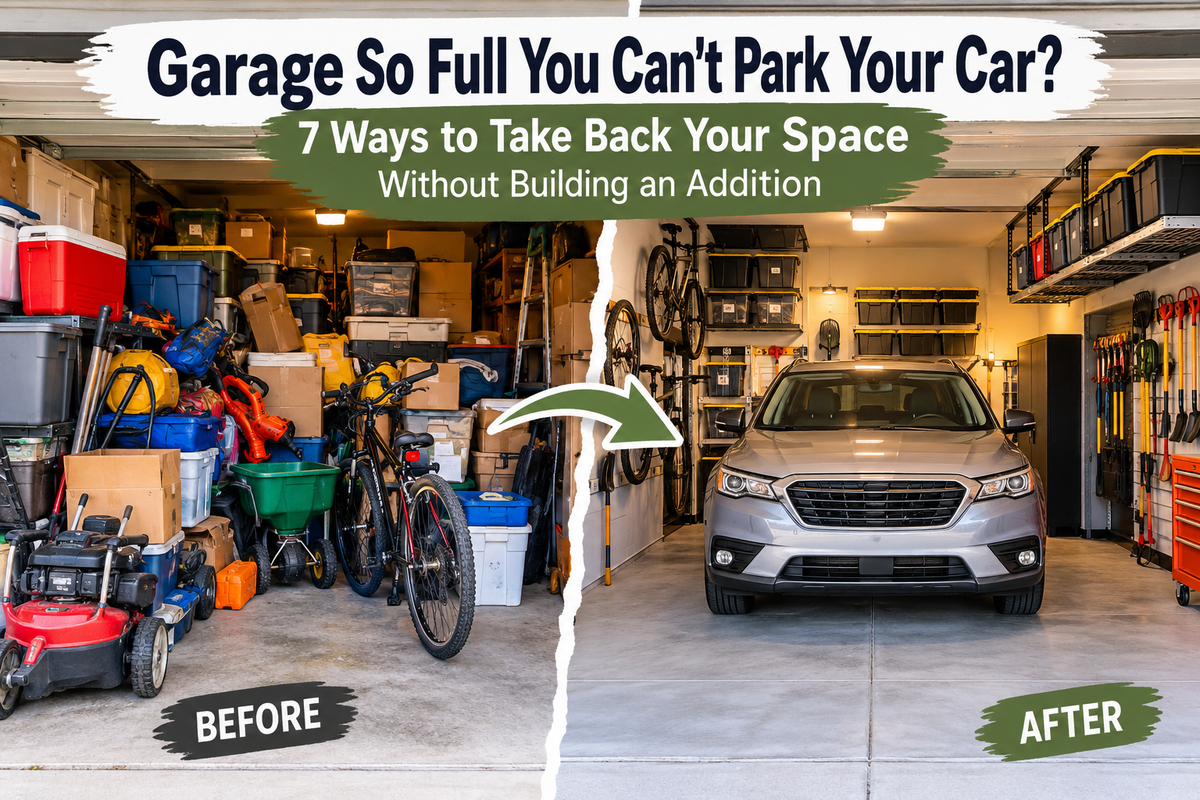
Garage So Full You Can't Park Your Car? 7 Ways to Take Back Your Space Without Losing Your Weekend
Garage So Full You Can't Park Your Car? 7 Ways to Take Back Your Space Without Losing Your Weekend
Feeling overwhelmed by a cluttered garage? You don't need an expensive renovation, a professional organizer, or an entire weekend to make progress. Here's a realistic plan for busy homeowners who just want their garage back.

It's Friday afternoon. You've worked all week, and the last thing you want to think about is cleaning out the garage.
But every time you pull into your driveway, there it is.
The lawn mower you have to squeeze around. The boxes you keep meaning to go through. The bicycles leaning against the wall. And somewhere behind everything is that tool you spent 20 minutes looking for last weekend.
Your garage is supposed to protect your car. Instead, your car sits outside while everything else has taken over.
You tell yourself, "I'll tackle it this weekend."
Then Saturday arrives. There's grocery shopping, errands, family time, yardwork, and about a hundred other things you'd rather do.
Sunday evening comes around, and the garage looks exactly the same.
Sound familiar?
Here's the good news: You don't have to give up your entire weekend to reclaim your garage.
You don't necessarily need expensive garage cabinets, a new storage shed, or a professional organizer, either.
What you need is a manageable plan, a realistic understanding of how long it might take, and a few smart garage storage solutions that actually fit your life.
Let's start with something simple.
1. How Do You Get Motivated When Your Garage Feels Completely Overwhelming?

Here's something most garage organization guides overlook: The hardest part isn't organizing. It's getting started.
When you look at a garage full of belongings, your brain doesn't see one small project. It sees an entire weekend of work.
And after working 40 or 50 hours all week, who wants another job?
Try the 20-Minute Garage Challenge
Instead of telling yourself you're going to clean the garage, make a much smaller commitment.
Set a timer for 20 minutes.
Pick one shelf, one box, or one corner.
That's your entire project for the day.
Put on your favorite music or podcast. Grab a trash bag and get started.
When the timer rings, stop.
Seriously.
You don't have to finish the garage. You only need to finish the small task you selected.
Why Small Projects Work
Large projects often feel intimidating because the finish line seems so far away. Breaking a project into manageable tasks makes progress easier to recognize.
Instead of measuring success by whether your entire garage is spotless, measure it by what you accomplished today.
One organized shelf is progress.
One cleared corner is progress.
One bag of unwanted belongings removed from the garage is progress.
Homeowner Tip: Take a picture before you start. After a few sessions, compare it with your progress. Small improvements can be surprisingly motivating when you see them side by side.
2. Where Should You Start Without Making an Even Bigger Mess?

One of the biggest mistakes homeowners make is pulling everything out of the garage at once.
Suddenly, the driveway is full, you're exhausted, and now you have to put everything back before the day ends.
Let's avoid that.
Start With One Three-Foot Section
Choose a small section of wall near the garage door or another easily accessible area.
Work only within that space.
Use three containers:
-
Keep: Items you regularly use or genuinely need.
-
Donate or Sell: Belongings that are still useful but no longer needed.
-
Trash or Recycle: Broken or unusable items, following local disposal requirements.
If something belongs elsewhere in your home, place it in a separate relocation basket.
Finish that small section before moving on.
Measure the Space Your Car Actually Needs
Before rearranging everything, measure your vehicle.
Write down its length and width, then account for room to open doors, walk around it, and access storage safely.
Use painter's tape to mark a parking boundary on the floor.
Now you have a clear goal: Keep that area open.
You may discover that the problem isn't the overall size of your garage. It's where everything is stored.
3. How Can You Create More Garage Storage Without Spending a Fortune?
Before investing in additional storage space, take a look at your walls.
Many garages have plenty of unused vertical space, even when the floor is crowded.

Put Your Garage Walls to Work
Wall-mounted storage can help keep tools and smaller equipment off the floor.
Consider these options:
| Storage Solution | Best For |
|---|---|
| Pegboard | Hand tools, tape measures, small accessories |
| Wall-mounted hooks | Rakes, shovels, hoses |
| Heavy-duty shelving | Storage bins and household supplies |
| Bicycle racks | Bikes and riding equipment |
| Garage cabinets | Tools, hardware, and workshop supplies |
| Overhead storage racks | Appropriate lightweight seasonal items |
For example, five gardening tools leaning against a wall can make a corner feel crowded.
Hang those tools on a properly installed rack, and suddenly the corner becomes easier to use.
What About Overhead Garage Storage?
The space above your garage floor may also offer storage opportunities.
Seasonal decorations, lightweight camping supplies, and infrequently used belongings are potential candidates.
However, overhead storage requires careful planning.
Check the manufacturer's load ratings, garage ceiling structure, vehicle clearance, and garage door operation. Heavy racks must be properly supported, and some installations require professional assistance.
Avoid storing hazardous materials or excessively heavy items overhead.
Money-Saving Tip: Before purchasing new garage storage systems, see whether you can repurpose existing shelving or containers. Just make sure they're appropriate for the weight and environment.
4. How Long Does It Really Take to Organize a Garage?

This is probably the question everyone wants answered.
And the answer is: It depends on how much you've accumulated.
But you can make a reasonable plan without committing an entire weekend.
Realistic Garage Organization Time Estimates
| Garage Condition | Estimated Work | Suggested Approach |
|---|---|---|
| Light clutter | 2–4 hours | Several short sessions |
| Moderate clutter | 6–10 hours | Two to three weeks |
| Heavy clutter | 12–20+ hours | Several weeks, one section at a time |
These are illustrative planning estimates, not measured averages. Actual time varies with garage size, volume of belongings, disposal needs, and physical assistance required.
Try the Five-Day Weeknight Garage Reset
Here's a manageable schedule for homeowners who want to protect their weekends.
| Day | Your Task | Time |
|---|---|---|
| Monday | Clear one shelf or small corner | 20 minutes |
| Tuesday | Sort one box of belongings | 20 minutes |
| Wednesday | Organize frequently used tools | 20 minutes |
| Thursday | Prepare a donation or recycling bag | 20 minutes |
| Friday | Sweep your cleared space and review progress | 15 minutes |
| Saturday | Enjoy your weekend | 0 minutes |
| Sunday | Enjoy your weekend | 0 minutes |
That's less than two hours of focused work spread across five evenings.
Will your entire garage be finished? Maybe not.
But you'll have made meaningful progress without sacrificing Saturday and Sunday.
And if you miss a day? Just continue when you're ready.
This isn't a race.
5. Can You Organize Your Garage Alone, or Should You Ask for Help?

You might be surprised how much you can accomplish on your own.
Sorting boxes, organizing small tools, labeling containers, and clearing lightweight clutter are tasks many homeowners can manage independently.
But there are situations where asking for help makes sense.
Tasks You Can Often Handle Yourself
-
Sorting household belongings
-
Organizing small tools
-
Labeling storage containers
-
Creating storage zones
-
Moving lightweight items
-
Planning your garage layout
When Should You Ask for Help?
Consider recruiting family, friends, or professionals when dealing with heavy equipment, large cabinets, overhead storage installation, unstable stacks, hazardous materials, or substantial junk removal.
And here's something worth considering: You don't necessarily need to hire someone for an entire garage makeover.
Sometimes a few hours of help moving large items or hauling away unwanted belongings is enough to get the project moving.
Is a Professional Organizer Worth the Money?
It depends on your situation.
A professional organizer may be helpful when you're overwhelmed by decision-making, have limited physical ability, or need assistance designing a system that works for your household.
Before hiring anyone, ask what's included, how pricing works, whether hauling and disposal are separate, and whether they'll help you maintain the system afterward.
Remember: The goal isn't to create a picture-perfect garage. It's to create one you can comfortably use.
6. What If You Organize Everything and Still Don't Have Enough Storage Space?

Sometimes clutter isn't the only problem.
You may simply have more equipment than your garage can comfortably hold.
A riding mower, snowblower, wheelbarrow, bicycles, seasonal decorations, and workshop equipment can consume a surprising amount of space.
Before considering a garage addition, determine exactly what needs to move.
Measure Your Largest Items First
Here's an example:
| Equipment | Illustrative Floor Space |
|---|---|
| Push lawn mower | 12.5 sq. ft. |
| Snowblower | 11.25 sq. ft. |
| Large storage cabinet | 8 sq. ft. |
| Unused furniture | 15 sq. ft. |
| Total | 46.75 sq. ft. |
These are examples only; actual equipment dimensions and clearance requirements vary.
Moving or removing those items could free up nearly 47 square feet of garage floor space.
That might be enough to improve vehicle clearance or restore a usable walking path.
Should You Consider a Backyard Storage Shed?
An outdoor shed can be useful when bulky lawn equipment, garden tools, and seasonal belongings are consuming space needed for parking or other activities.
But choosing the right size matters.
| Nominal Shed Size | Floor Area | Potential Uses |
|---|---|---|
| 8 × 10 ft | 80 sq. ft. | Gardening tools, bicycles, seasonal supplies |
| 8 × 12 ft | 96 sq. ft. | Lawn mower, snowblower, shelving |
| 10 × 12 ft | 120 sq. ft. | Multiple pieces of outdoor equipment |
| 12 × 20 ft | 240 sq. ft. | Larger equipment and substantial storage needs |
A shed's advertised footprint isn't necessarily its usable interior area.
Always check door dimensions, equipment clearance, foundation requirements, anchoring, and local regulations.
For cold or snowy regions, verify that the specific shed or shelter has appropriate documented wind and snow load ratings.
What About Portable Storage Shelters?

Portable shelters can be another option for larger equipment such as tractors, utility trailers, or recreational vehicles.
However, they're not interchangeable with permanent garages.
Material quality, anchoring, ventilation, maintenance, and weather ratings all matter.
If you're comparing options, focus on what you actually need to store—not simply buying the largest structure available.
Helpful Resource: Home Outpost Supply offers outdoor storage solutions and homeowner education to help you explore different approaches after you've measured your needs.
But remember: Additional storage should solve a genuine space problem, not become another place to accumulate things you no longer use.
7. How Do You Keep Your Garage Organized Without Constantly Cleaning It?

Here's the part nobody wants to talk about.
You finally get your garage organized.
Six months later, the clutter starts creeping back.
Why?
Usually because the organization system is too complicated or doesn't match how the space is used.
Create Four Simple Garage Zones
Parking Zone: Keep enough space clear for vehicles, doors, and safe movement.
Tool Zone: Store frequently used tools together and within easy reach.
Seasonal Zone: Group holiday decorations, camping equipment, and seasonal supplies.
Outdoor Equipment Zone: Keep lawn and garden equipment in a designated location, whether inside the garage or in suitable separate storage.
Try the One-Minute Rule
Frequently used belongings should be easy to retrieve and return to their designated locations in about a minute.
If you have to move five boxes to reach your lawn mower, your storage arrangement probably needs improvement.
The Five-Minute Weekly Reset
Once a week, spend five minutes returning misplaced items to their proper places.
Check that walkways remain clear, put tools away, and remove packaging or trash.
Five minutes is much easier than another exhausting weekend cleanout.
Frequently Asked Questions About Garage Organization
What Is the Easiest Way to Organize a Garage That's Completely Full?
Start with one small area instead of emptying the entire garage. Set a timer for 20 minutes, remove obvious trash, sort belongings into keep and donate categories, and finish that section before moving on.
How Can I Motivate Myself to Clean My Garage?
Focus on one achievable task rather than the entire project. Take a before photo, play music, and work in short sessions. Visible progress can help build motivation.
Can I Organize My Garage Without Spending Money?
Yes. Start by decluttering, relocating belongings, and using existing shelving more effectively. You may discover that you don't need additional storage equipment.
How Long Should a Garage Cleanout Take?
A lightly cluttered garage might require a few hours, while a heavily cluttered space may require 12–20 hours or more. Breaking the work into shorter sessions can make the project easier to manage.
Should I Organize My Garage or Buy a Storage Shed?
Organize first. Once you've removed unnecessary belongings and measured your equipment, you'll know whether you genuinely need more storage space.
Can I Store My Lawn Mower and Snowblower in an Outdoor Shed?
Often, yes, provided the shed has suitable dimensions, access, ventilation, and storage conditions. Follow the equipment and shed manufacturers' guidance, particularly regarding fuel and batteries.
What's the Best Way to Keep Garage Clutter From Returning?
Give frequently used items designated locations, make them easy to put away, and establish a short weekly maintenance routine.
Your First 20 Minutes Start Today
You don't need to wait until next weekend.
You don't need to order expensive storage equipment.
And you certainly don't need to organize your entire garage in one day.
Here's your first assignment:
The 20-Minute Garage Starter Checklist
-
Choose one shelf, box, or small corner.
-
Take a quick before photo.
-
Set a timer for 20 minutes.
-
Remove obvious trash and unwanted items.
-
Put the remaining belongings in order.
-
Take an after photo and enjoy your progress.
That's it.
Tomorrow, if you have another 20 minutes, choose another small area.
If not, pick it up when you're ready.
Little by little, you'll begin to see more floor space, fewer piles, and a garage that actually works for you.
Final Thoughts: Your Weekends Are Worth Protecting, Too
Your garage doesn't need to look like something out of a home improvement magazine.
It just needs to make your life easier.
Maybe that means finally parking your car inside again.
Maybe it's finding your tools without searching through piles of boxes.
Or maybe it's simply opening the garage door without feeling overwhelmed.
Whatever your goal, remember that small improvements add up.
One shelf today. One corner tomorrow. A little more floor space next week.
And eventually, you may discover you don't need nearly as much additional storage as you thought.
At Home Outpost Supply, we believe taking care of your home shouldn't mean sacrificing every free weekend.
Start small. Make progress. Get your weekends back.
We'd Love to Hear From You!
What's the biggest thing keeping you from organizing your garage?
Is it finding the time, getting motivated, not knowing where to start, or simply having too much stuff?
Share your biggest garage challenge with us on Facebook. You might discover you're not the only one dealing with it!
Home Outpost Supply — Making homeownership a little easier, one project at a time.



Leave a comment
This site is protected by hCaptcha and the hCaptcha Privacy Policy and Terms of Service apply.