


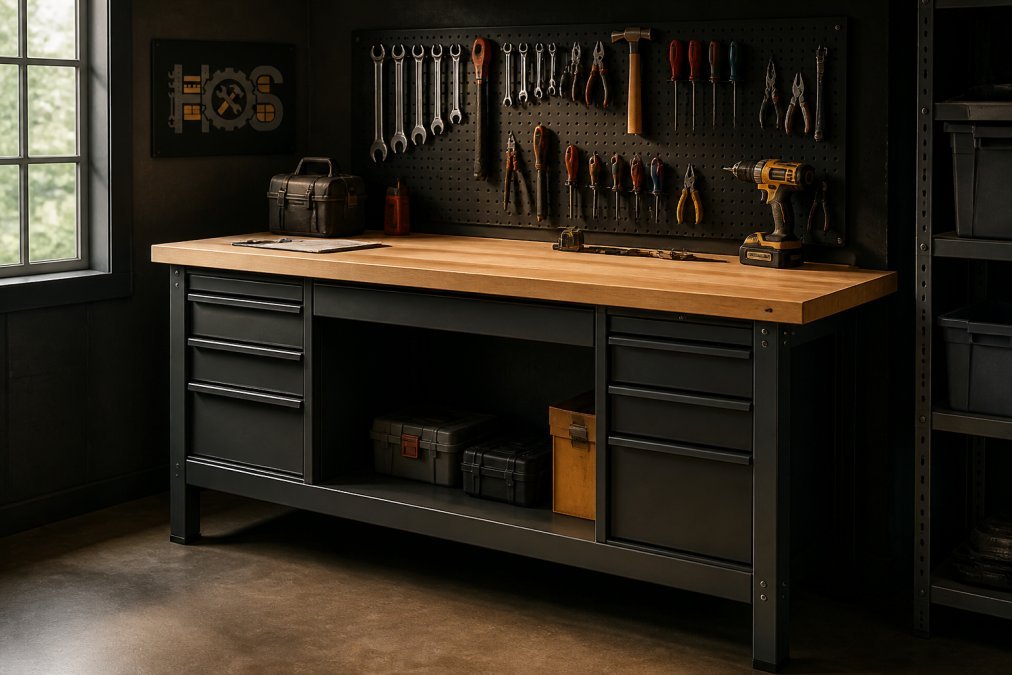
6 Foot Workbench with Drawers: Buyer's Guide for 2026
Table of Contents
- What a 6 Foot Workbench with Drawers Actually Gives You
- Quick Comparison: 6 Foot Workbench Options at Home Outpost Supply
- Heavy Duty Garage Workbench: What Separates Real Load Capacity from Marketing Claims
- Drawer Configuration, Weight Limits, and Slide Quality
- Adjustable Height Workbench with Drawers: Does It Exist at 6 Feet?
- Rolling vs. Stationary Bases, Assembly, and Delivery Logistics
- Garage Organization Tips: Setting Up Your Workbench for Real Work
- Work Surface Materials and Long-Term Maintenance
- Frequently Asked Questions
Last Updated: September 24, 2026
What a 6 Foot Workbench with Drawers Actually Gives You
A 6 foot workbench with drawers is the middle child of garage workstations: long enough for real projects, short enough for a two-car garage. Buyers agonize over length when the real decision is load capacity and drawer quality.
A 6-foot bench gives you roughly 72 inches of work surface, enough for a miter saw station or a small engine tear-down. The drawers replace the toolbox stack you keep tripping over.
Most guides bury the two numbers that determine whether the bench survives five years: desktop load rating and per-drawer slide capacity.
Quick Comparison: 6 Foot Workbench Options at Home Outpost Supply
The closest true 6-foot option is the 6ft Heavy Duty Mobile Workbench with 10 Drawers at $1,599.00: 66.77 inches wide, 24.57 deep, 36.06 tall, 418 lbs, with an 880 lb desktop rating, the one to buy if your garage is tight and you want mobility.

| Model | Width | Desktop Capacity | Drawers | Price |
|---|---|---|---|---|
| 6ft Mobile Workbench, 10 Drawers | 66.77 in | 880 lbs | 10 | $1,599.00 |
| 7ft Workbench, 10 Drawers & 2 Cabinets | 87.8 in | 1,654 lbs | 10 | $1,899.00 |
| 7ft Garage Workbench, 18 Drawers & 4 Cabinets | 87 in | Not listed | 18 | $2,699.00 |
| 10ft Workbench, 15 Drawers & 2 Cabinets | 113 in | 1,653 lbs | 15 | $2,599.00 |
Heavy Duty Garage Workbench: What Separates Real Load Capacity from Marketing Claims
A heavy duty garage workbench earns that label through three things: distributed weight capacity that matches how you load the top, a steel frame that resists flexing, and corrosion resistance that survives a humid garage.
Desktop Load Ratings and Distributed Weight Capacity
Desktop ratings assume distributed load, not a single point. An 880 lb rating means that weight spread across the top; park a 400 lb engine block on one corner and you are testing something else.
Frame Material, Powder-Coated Steel, and Corrosion Resistance
Powder coating is not cosmetic. Our units run through degreasing, descaling, phosphating, then the powder coat, pretreatment that stops rust creeping under the finish in a garage swinging between humid summers and cold winters.
Drawer Configuration, Weight Limits, and Slide Quality
Drawer count is the least useful spec on the page. A 30-drawer bench with weak slides is worse than a 10-drawer bench you can load without thinking.
Adjustable Height Workbench with Drawers: Does It Exist at 6 Feet?
An adjustable height workbench with drawers at 6 feet is uncommon. Adjustability adds frame complexity, and most manufacturers reserve it for smaller benches or standing desks. At 72 inches, a crank or electric column fights more flex, and the drawer stack competes with the lifting mechanism for the same vertical space, which is why adjustable benches appear at 48 to 60 inches far more often than at 6 feet.
Task-Based Height Selection
Workbench height should be set relative to your elbow, not your height in inches: the surface should sit just below a relaxed elbow for your most frequent task.
- Heavy assembly, hammering, and pry-bar work: Set the surface at or slightly below elbow height, roughly 32 to 34 inches for an average adult. You want to drive force downward through the work, not lift it. A lower bench lets you put body weight behind a hammer instead of arm strength.
- General repair, wrenching, and power-tool work: Elbow height, around 34 to 36 inches. This is the range most fixed benches ship at, and it is why they feel right for most garage jobs.
- Precision work, soldering, small electronics, fine measuring, layout: Set the surface 4 to 6 inches above elbow height, roughly 38 to 42 inches. You want the work close to your eyes so you can see detail without hunching your neck. This is where a dedicated electronics bench or standing desk converter earns its keep.
- Detailed inspection or long sessions with small parts: Sit, and set the surface at seated elbow height, roughly 27 to 30 inches. A stool plus a lower bench beats standing for hours of fiddly work.
Leveling Feet, Floor Slope, and the Drawer Trade-Off
If true adjustability matters more than length, pair a shorter adjustable bench with a rolling tool chest rather than one 6-foot adjustable unit. That gives you ergonomic range and drawer capacity without asking one frame to do both jobs.
6ft Heavy Duty Mobile Workbench with 10 →
Rolling vs. Stationary Bases, Assembly, and Delivery Logistics
Rolling bases win for garages that double as parking space: locking casters let you push the bench against the wall when the car comes home, then roll it out for a project. The trade-off is that casters reduce the effective load you should place on the top.
Garage Organization Tips: Setting Up Your Workbench for Real Work
The bench is only half the system. Where you put it and how you organize around it decides whether it becomes a workstation or a shelf for junk.
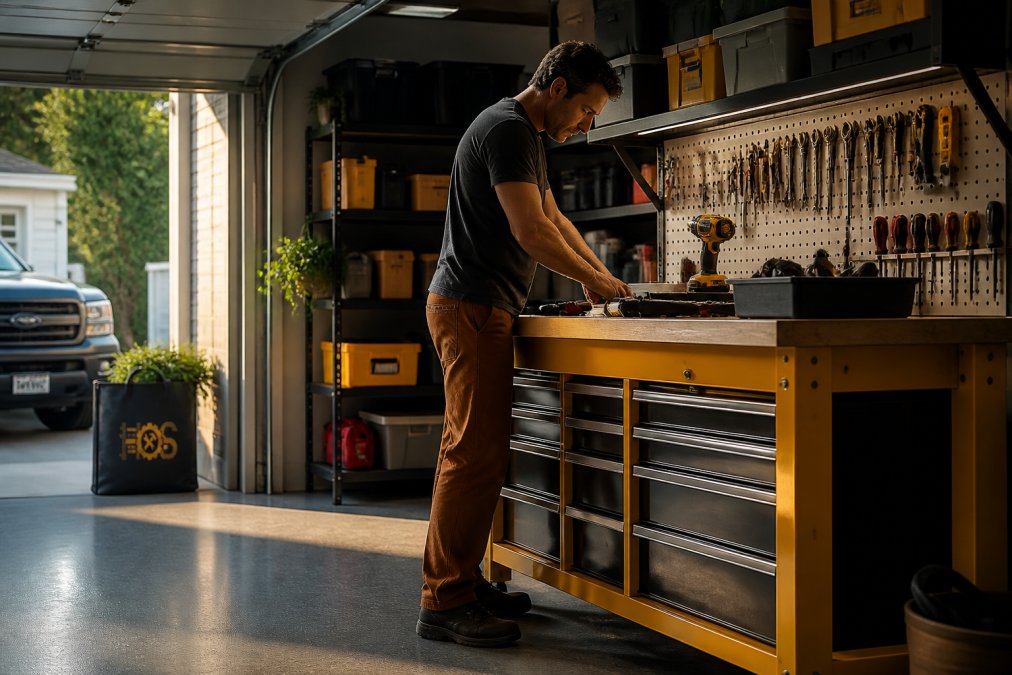
Ergonomic Setup: Height, Reach, and Lighting
Set your most-used tools between waist and shoulder height: sockets, wrenches, and drivers in upper drawers or on the pegboard, heavy power tools in lower cabinets where lifting is safer.
Small-Space Optimization for Tight Garages
A 6-foot bench is already the small-space answer, but you can push it further. Go vertical: pegboard above the bench, shelves above that, and nothing on the floor underneath, so you can roll it out when you need room on all sides.
Work Surface Materials and Long-Term Maintenance
Work surface choice comes down to hardwood versus steel, and both work if you maintain them. What most guides skip is the maintenance itself, specifically how to seal a hardwood top so it survives oil, solvent, and chemical spills, the most common complaint from garage users who watch a rubberwood bench stain within a year.
Hardwood Tops: Sealing, Oiling, and Stain Prevention
A rubberwood or maple top is quieter, kinder to chisels and finished surfaces, and easier on your hands. It also dents, stains, and needs periodic care. The difference between a top that looks new in five years and one wrecked in one is whether you seal it before the first spill.
Steel Tops: What They Resist and What They Don't
A steel top with a plywood liner, which our units use, handles solvents, hot parts, and heavy impacts without complaint. Wipe it down, keep it dry, and it outlasts the garage. The plywood liner is sacrificial, flip or replace it when chewed up, without replacing the steel.
A Simple Annual Maintenance Routine
Maintenance is simple on either surface, but it needs to happen:
- Clear sawdust and metal shavings regularly. They trap moisture against the finish and accelerate rust on steel or mildew on wood.
- Inspect the powder coat on the frame once a year and touch up any chips before rust gets a foothold. A $6 can of matching touch-up paint prevents a $600 problem.
- Check drawer slides for grit and wipe them clean. A dry brush or a shop vac gets grit out of ball-bearing races without flushing the grease.
- Re-oil hardwood tops and re-wax or re-coat as needed.
- Check leveling feet and caster bolts for loosening, especially if the bench rolls.
Frequently Asked Questions
Is it cheaper to buy or build a 6 foot workbench with drawers?
Building a basic 6 foot workbench from lumber often costs less in materials, but it rarely includes locking drawers, ball-bearing slides, or a load-rated steel frame. A pre-built steel unit such as the 6ft Heavy Duty Mobile Workbench with 10 Drawers at $1,599 arrives assembled with a 880 lb desktop capacity and 33 lb drawer capacity, so you skip the weekend build and get tested load ratings. If your priority is drawer storage and durability, buying usually wins.
How tall should a workbench be for a 6 foot person?
Most workbenches land between 36 and 39 inches tall. At 6 feet, a surface around 38 to 39 inches keeps your wrists neutral for assembly and detail work, while 36 inches suits tasks where you lean in and push, like planing or sawing. The 6ft Heavy Duty Mobile Workbench sits at 36.06 inches, and the 7ft Heavy Duty Workbench with 10 Drawers and 2 Cabinets sits at 38.19 inches, so measure your natural elbow height before choosing.
What features should I look for in a heavy duty garage workbench?
Check four things: desktop bearing capacity, drawer bearing capacity, slide type, and frame construction. A heavy duty garage workbench should list a desktop rating in the hundreds to 1,600-plus lb range, drawers rated 33 to 110 lbs each, ball-bearing three-section slides, and all-welded steel construction with a powder-coated finish. Pre-cut non-slip drawer liners and locking drawers are worth having. The 7ft Heavy Duty Workbench with 10 Drawers and 2 Cabinets lists a 1,654 lb desktop capacity and 88 lb drawers.
Can a 6 foot workbench with drawers fit in a small garage?
Yes. A 6 foot unit runs about 66 to 68 inches wide and roughly 24 inches deep, so it fits along most single-car garage walls while leaving room to park. Measure door clearances and unloading access first, since these units ship on pallets and need a forklift or equivalent at delivery. If you need more storage without more floor space, consider a taller 7ft cabinet with 32 drawers that stacks storage vertically instead of spreading out.


Leave a comment
This site is protected by hCaptcha and the hCaptcha Privacy Policy and Terms of Service apply.